Tight Hips After 50: Why Your Hips Hold the Key to Your Back and Knees
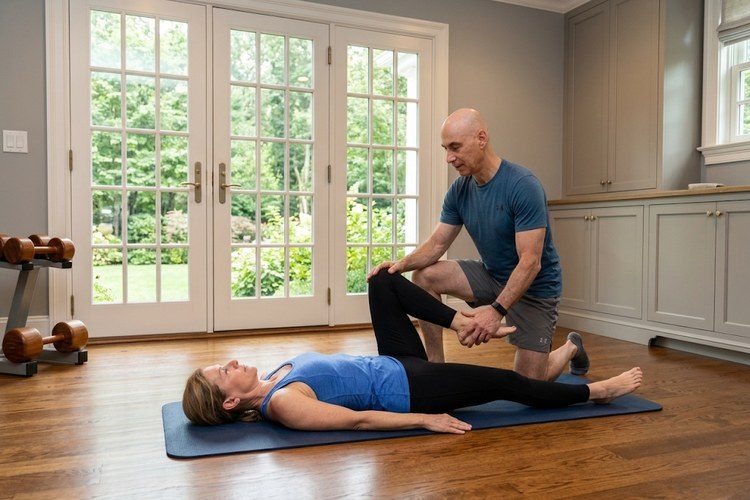
If there is one thing nearly every client I train has in common, it’s tight hips. I see it in the first session: most people can’t comfortably get into a basic piriformis stretch — lying on your back with one ankle crossed over the opposite knee — and almost always, one side is noticeably tighter than the other.
It’s not surprising. We sit at desks, sit in cars, and sit at dinner. Over the years, the muscles around the hip shorten, stiffen, and weaken, and most people don’t notice until their back aches, their knees complain, or getting out of a low chair takes a little push.
This is the third post in The Injury-Proofing Series, following the back and knee posts. In many ways, the hip ties them together.
The Hip Is the Hub
Your hips sit right between your low back and your knees, and they affect both. Tight hips pull on the low back. Weak hips let the knees drift inward with every step. When clients come to me with back or knee complaints, the hips are almost always part of the conversation.
It works the other way too. Weak quads, stiff ankles, or a tight low back change how the hip has to move. You don’t need to memorize the anatomy. Just know that the body works as a chain, and the hip is the strongest link in the middle of it — when it’s loose and strong, everything above and below it tends to work better.
Where Tightness Hides
Three areas account for most of the hip tightness I see:
- The front of the hip (psoas and hip flexors): These muscles connect your spine and pelvis to your thigh. Hours of sitting keep them in a shortened position, and over time they stay that way — pulling on the low back when you stand up straight.
- The side of the hip (glute med): This muscle keeps your pelvis level and your knee tracking straight every time you stand on one leg, which is every step you take. It’s often tight and weak at the same time.
- Deep in the buttock (piriformis): A small muscle underneath the glutes that helps rotate the hip. The sciatic nerve runs right next to it — and in some people, through it. When the piriformis is tight, it can mimic or aggravate sciatic-type pain down the back of the leg.
A quick but important note: most true sciatica starts in the low back, not the hip. If you have numbness, weakness, or pain shooting below the knee, get it checked by your doctor first. Once you’re cleared, the work below can make a real difference.
For everyday tightness, a few minutes most days goes a long way:
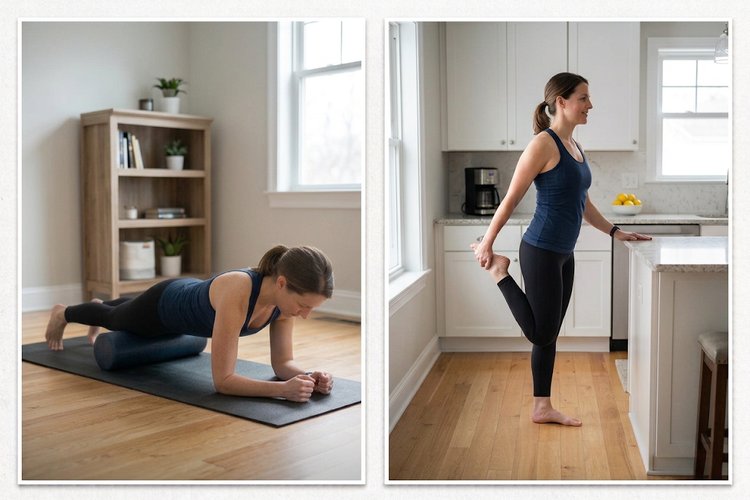
- Roll the glutes and piriformis: Sit on a foam roller or massage ball, cross one ankle over the opposite knee, and lean into that side. 1–2 minutes per side.
- Roll the side of the hip: Lie on your side on the roller and work the area just below the hip bone.
- Figure-4 stretch: On your back, ankle over the opposite knee, gently pull the bottom leg toward you. 30 seconds per side.
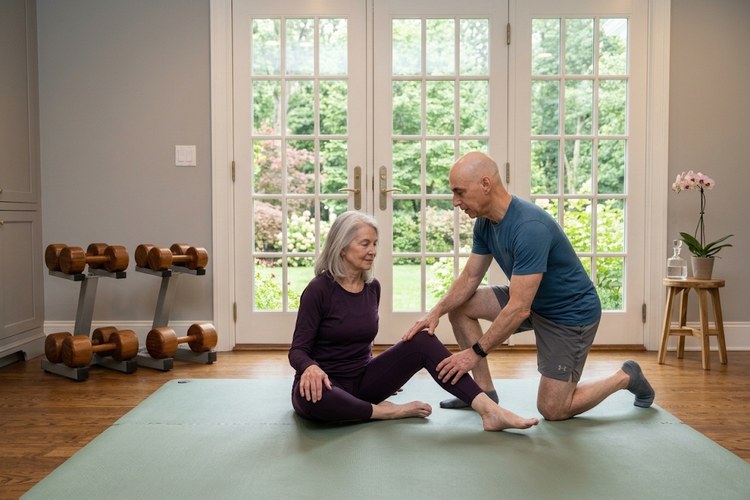
- Hip flexor stretch: Half-kneeling, one knee on a cushion, tuck your hips under and shift gently forward. 30 seconds per side.
Spend a little extra time on your tighter side. Evening out the difference is part of the goal.
Strength: Building Hips That Hold Up
Stretching loosens the hips. Strength keeps them that way. Tight hips are very often weak hips too, and stretching alone rarely solves the problem.
My foundation for hip strength is simple: glute bridges, then single-leg bridges; clamshells and side-lying leg raises for the side of the hip; and band walks to tie it together. From there we build to squats, working steadily toward a full squat as each person can tolerate it.
And then there are lunges, which I believe are critically important. A lunge trains the hip the way life uses it: one leg at a time, with balance, through a real range of motion. It’s how you climb stairs, step off a curb, and get up off the floor. We start gently — short steps, holding a counter or a doorframe for support, only as deep as is comfortable — and progressively build depth, add light weight, and add variety like reverse and lateral lunges over time. Done that way, lunging is one of the best investments you can make in your hips.
The Myth | What’s Actually True |
“Tight hips are just part of getting older.” | Most hip tightness comes from sitting and inactivity — and it responds well to regular rolling, stretching, and strength work. |
“Stretching is all I need.” | Tight hips are often weak hips. Stretching helps, but strength is what keeps the hips loose and stable. |
“Lunges are too risky after 50.” | Started gently with support and progressed gradually, lunges are among the most valuable exercises for hip health. |
“With hip arthritis, I should avoid squats.” | Adjusting depth and angles keeps squats comfortable while you steadily work back toward fuller range. |
“After a hip replacement, strength training is over.” | Once you’re cleared, building strength is how you get the most out of your new hip. |
Based on principles from the American College of Sports Medicine (ACSM) and National Strength and Conditioning Association (NSCA) guidelines on exercise for special and clinical populations.
Arthritic Hips and Hip Replacements
Some of my clients live with arthritic hips, and more and more have had a hip replaced. I’m not here to diagnose or treat either — that’s the job of your orthopedic doctor and physical therapist. My role is continuation of care.
For arthritic hips, we follow your doctor’s and therapist’s guidance and adjust as needed — changing the angle or depth of a squat, for example, so it stays comfortable — while steadily working toward a fuller range of motion. Keeping the joint moving and the muscles around it strong is a big part of staying comfortable.
For hip replacements, the precautions depend on how your surgery was done, so we follow your surgeon’s and therapist’s instructions to the letter. Once you’re cleared, we use the same foundation — bridges, side work, band walks, supported squats and lunges — to build general strength, and we progress your training at home as your PT or orthopedic doctor directs. The goal is simple: walking, climbing stairs, and getting in and out of the car with confidence.
Alignment and the Feet
Some knee issues trace back to structure: bow legs, knock knees, flat feet, or feet that roll inward (overpronation). These change how force travels up the leg, and the knee takes the brunt of it. You can’t change your bone structure, but you can do a lot around it.
I look at how a client stands, walks, and squats. We strengthen the hips and glutes that control where the knee travels — more on that in the upcoming hip post — and work on foot and ankle strength and mobility. Footwear matters, too. For some people, a gait analysis and a change of sneaker — or, under the right supervision, an insert or orthotic — can make a real difference.
Where DynaFlex Fits In
If you read the series overview, you know every session I run includes my DynaFlex series, and much of it is built for the hips: isolated hip circles, windshield wipers, bridging, and scorpions, along with high knees and backbend squats. It opens up tight hips, wakes up the glutes, and evens out side-to-side differences before any strength work begins.
Loose, Strong Hips Are Within Reach
Tight hips aren’t a life sentence, and you don’t need a complicated program to change them. Roll them, stretch them, strengthen them, and build back into squats and lunges the right way — and your back and knees will thank you too.
If you’re in Fairfield County and want help getting your hips moving better — whether you’re preventing problems or rebuilding after surgery — contact me here. We’ll start exactly where you are and progress at your pace
Carlos Perez, M.S. holds a Master’s degree in Exercise Science (Human Performance) from Southern Connecticut State University and is ACE certified as both an Orthopedic Exercise Specialist and Senior Fitness Specialist. He has provided private, in-home personal training to professionals in Greenwich, Stamford, Westport, and Darien since 2006, specializing in safe, efficient strength training for adults ages 45–70.