Cleared to Exercise But Afraid to Start: Training Safely After a Back Injury
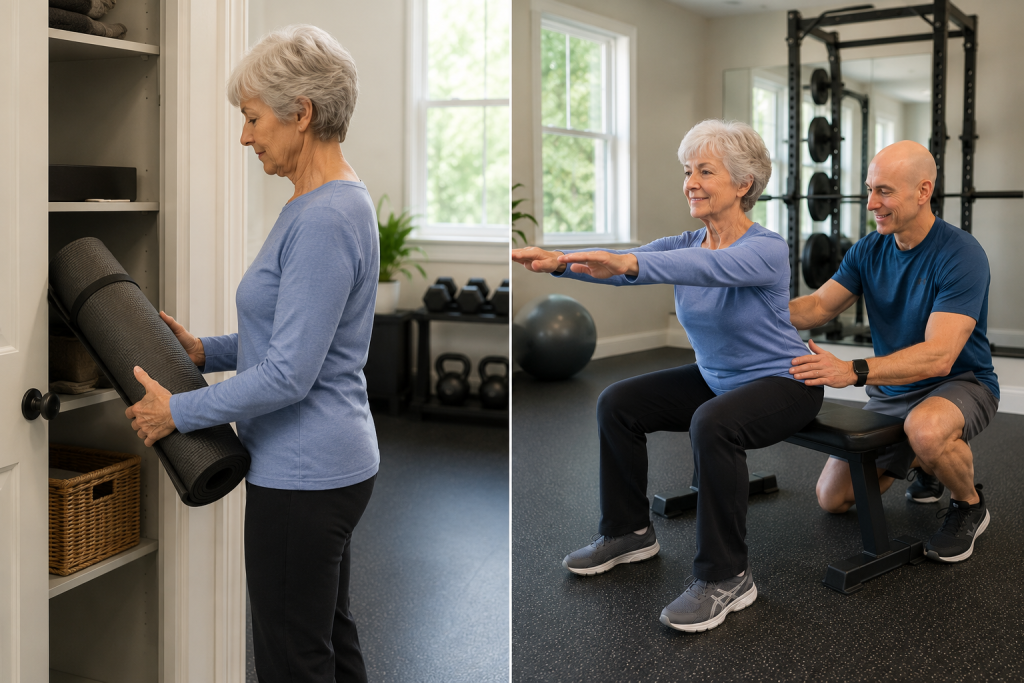
For nearly 20 years I have trained adults in their own homes across Fairfield County, and a version of the same conversation comes up again and again. Someone has finished physical therapy or recovered from back surgery. Their therapist told them, clearly, to keep exercising at home. And yet the mat stays rolled up in the closet. Not because they are lazy — but because they are afraid. Afraid that the wrong move will undo months of recovery. Afraid that hiring a trainer means being pushed too hard by someone who does not understand what their back has been through.
If that sounds familiar, this post is for you. My goal here is simple: to ease that fear with facts, and to show you exactly what safe, professional continuation of care actually looks like.
The Fear Is Understandable — And Common
When your back has failed you once, trusting it again is hard. A herniated disc, a surgery, a stretch of sciatica that put you flat on your back for a week — experiences like these leave a mark that is as much psychological as physical. The body heals faster than the confidence does.
This is one of the most well-documented patterns in rehabilitation: fear of movement, sometimes called kinesiophobia, is itself a major obstacle to recovery. People avoid the very activity that would strengthen and protect them, and in doing so they lose more strength, more mobility, and more confidence. The deconditioning that follows can leave the back weaker and more vulnerable than the original injury did.
The important thing to understand is that your therapist did not tell you to keep exercising as a formality. They told you because continued, appropriate loading is what keeps your spine resilient. Stopping is the risk. The question is not whether to keep going — it is how to do it safely.
What People Fear vs. What Actually Happens
Most of the fear around training after a back injury comes from imagining the wrong picture — boot-camp intensity, heavy barbells, someone shouting “one more rep.” That is not what orthopedic and post-rehab training looks like. Here is the reality next to the fear:
The Fear | What People Imagine | What Actually Happens |
“I’ll reinjure my back.” | Heavy lifting, forced stretching, pushing through pain. | Movement is assessed first, loads start light, nothing is done through pain. |
“A trainer will push me too hard.” | Boot-camp intensity, ignoring limitations. | Programs are built around your restrictions, not against them, and progress gently. |
“Exercise caused this, so exercise will make it worse.” | Any loading of the spine is dangerous. | Controlled, progressive strengthening is one of the most protective things you can do for your back. |
“I’m too fragile to start.” | My body can’t handle any real work. | Your therapist cleared you to continue for a reason. The body adapts when loaded appropriately. |
Based on principles from the American College of Sports Medicine (ACSM) and National Strength and Conditioning Association (NSCA) guidelines on exercise for special and clinical populations.
Continuation of Care, Not Replacement of It
Here is what I want to be clear about, because it is the heart of how I work: I do not replace your physical therapist or chiropractor. I continue what they started.
Over the years I have built working relationships with physical therapists and chiropractors throughout Greenwich and the surrounding towns. When a client comes to me after finishing formal rehab, the goal is a seamless handoff — not a hard reset. I use my orthopedic exercise and senior fitness certifications to design programs that pick up where your therapy left off and carry it forward: rebuilding strength, restoring confident movement, and protecting you against the next injury.
That collaboration matters. Your therapist addresses the acute problem and gets you to a baseline. But therapy ends, and the exercises you were given are meant to continue — progressively, and under guidance if you want it. That middle ground, between the clinic and going it alone, is exactly where a qualified trainer belongs. Strengthening the back and core is a core part of what I do, and it is done with the same safety-first mindset your clinicians used.
Sources: American College of Sports Medicine (ACSM); National Strength and Conditioning Association (NSCA); research on sarcopenia and aging physiology.
What a First Session Actually Looks Like
The unknown is a big part of the fear, so let me make it concrete. A first session with someone recovering from a back injury is calm, slow, and almost entirely about assessment. Nobody is going to hand you a heavy weight and see what happens.
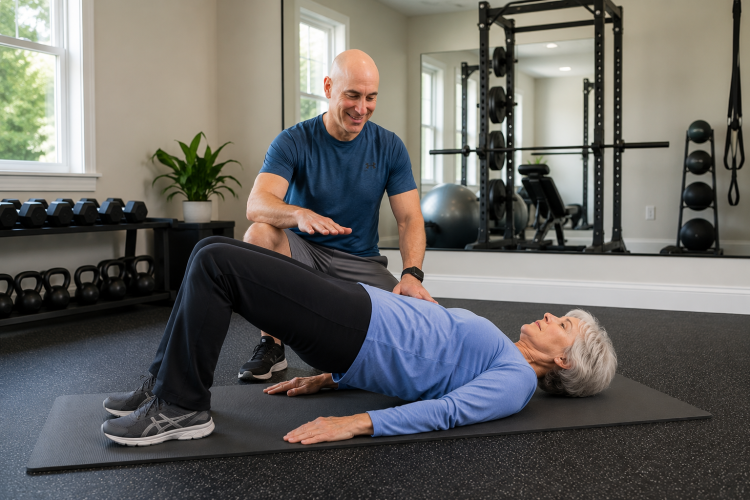
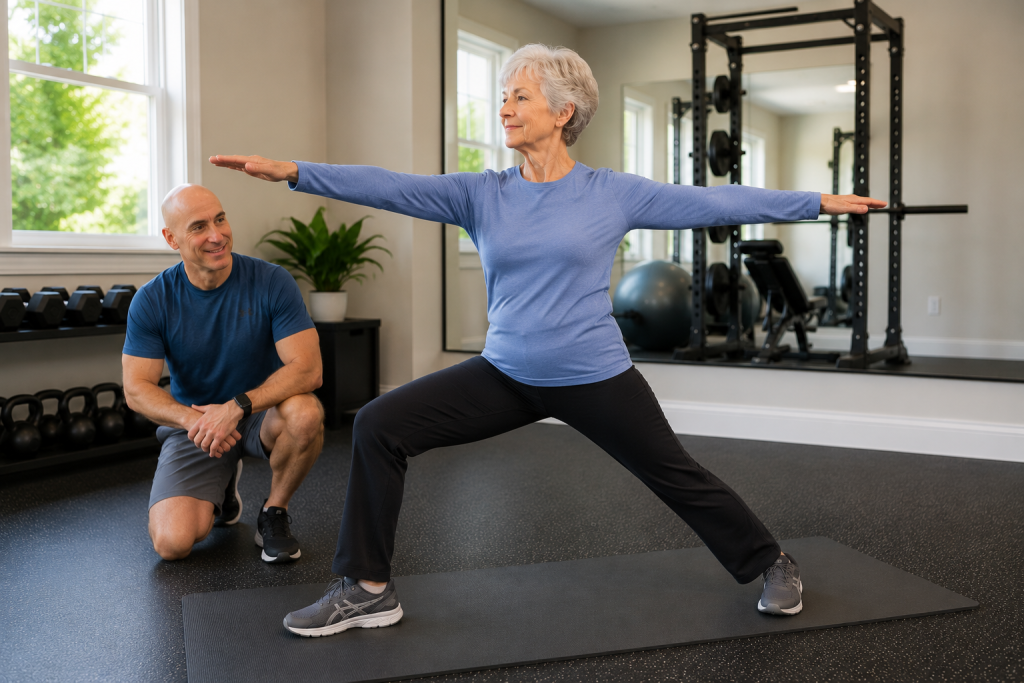
We start by watching how you move — how you bend, how you stand, how you shift your weight — looking for limitations and compensations. For someone coming off back surgery or back rehab, much of the early work is a direct continuation of what you were already doing: floor work, bridging, and gentle core activation, then progressing to standing movement such as high knees and dynamic flexibility routines. Everything is gradual. We add difficulty only when the previous step is clean and pain-free.
Stage | What We Actually Do |
Movement assessment | We watch how you move — bending, standing, shifting weight — to see where range is limited and where you compensate. |
Continuation of rehab work | We pick up the floor work, bridging, and core activation you were already doing in therapy, so nothing feels foreign. |
Standing & dynamic movement | Gentle standing patterns such as high knees and dynamic flexibility routines to rebuild confidence in motion. |
Gradual progression | Nothing is rushed. We add load and complexity only when the previous step is clean, controlled, and pain-free. |
By the end of a first session, most people feel something they had not expected: relief. The movements are familiar. Nothing hurt. And for the first time since their injury, they have someone watching their form and telling them, with authority, that what they are doing is safe.
Why Strengthening Is Protection, Not Risk
It is worth stating plainly, because so many people believe the opposite: a strong, well-conditioned back and core is your best protection against future injury. The research on this is consistent. Progressive resistance training and targeted core work reduce the likelihood of recurrent back pain and improve function in people who have been through injury or surgery.
The spine is meant to be loaded — appropriately, and with good mechanics. Muscles that support the spine respond to training the same way any other muscle does. When they are strong, they share the load and keep the vulnerable structures protected. When they are weak from disuse and fear-driven avoidance, everything else has to compensate. Done correctly, strengthening is not the thing that hurts your back. It is the thing that keeps it safe.
You Do Not Have to Do This Alone
If your therapist told you to keep exercising and you have been putting it off because you are afraid of getting hurt, that fear is understandable — but it does not have to be the end of the story. The right guidance turns an intimidating instruction into a clear, safe, step-by-step plan.
You can read more about my safety-first approach and the certifications behind it on my personal training services page, and see how I work with clients across Greenwich, Stamford, and Westport.
If you are in Fairfield County, recovering from a back injury, and want to continue your care with someone who trains safely and collaborates with your clinicians, contact me here. We can start exactly where you are — gently, and at your pace.
Carlos Perez, M.S. holds a Master’s degree in Exercise Science (Human Performance) from Southern Connecticut State University and is ACE certified as both an Orthopedic Exercise Specialist and Senior Fitness Specialist. He has provided private, in-home personal training to professionals in Greenwich, Stamford, Westport, and Darien since 2006, specializing in safe, efficient strength training for adults ages 45–70.