Knee Pain After 50: Why Tight Quads Matter More Than You Think
“Knee pain” is one of the broadest complaints I hear. It can mean a knee that aches on the way down the stairs, one that stiffens after a long drive, one that was surgically repaired thirty years ago and has started talking again, or one that has simply worn down with time. Because it covers so much ground, people often assume the answer lives entirely in a doctor’s office — scans, injections, and eventually surgery.
After nearly 20 years of training adults in their own homes across Fairfield County, I have seen something different. For a great many people, a meaningful part of the solution is something they can do themselves, at home, with a little guidance. Not everything, and not for every knee — but far more than most people expect.
This is the second post in The Injury-Proofing Series, following training safely after a back injury. Here is what you can actually do for your knees — starting before they become a problem.
The Knee Is the Middle Man
The knee is a fairly simple hinge sitting between two complicated neighbors: the hip above it and the foot and ankle below. It takes load from both. When the muscles around it are tight, weak, or pulling unevenly — or when the hip or foot isn’t doing its share — the knee absorbs the difference.
That is why the knee is so often where you feel the problem, even when it isn’t where the problem starts. And it is good news, because most of what surrounds the knee is muscle and soft tissue. Muscle responds to care and training at any age.
Prevention First: The Tight-Quad Problem
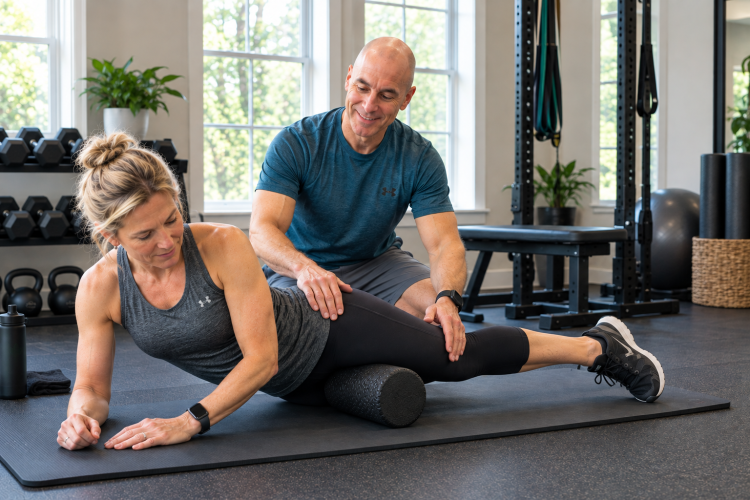
Here is a scene that plays out in my sessions more often than you would guess. A client meets me at the door and says something is wrong with their knee — it’s sore, achy around the kneecap, uncomfortable on the stairs. Before anything else, we get on the floor with a foam roller and slowly work through the quadriceps, the big muscle group on the front of the thigh, spending extra time on the inner quad just above the knee. Ten minutes later, much of that pain is gone.
Why does that work? The quadriceps muscles all attach to the kneecap, and through the patellar tendon, to the shinbone. When those muscles stay tight — from hours of sitting and driving, hard training without recovery, or simply years of neglect — they keep constant tension on the kneecap and tendon. Over time, that tension shows up as pain at the front of the knee. Easing it doesn’t fix every knee problem, but for many people it takes a real load off the joint.
This is the part I most want people in their 40s and 50s to hear, before the knee becomes a problem. Regularly rolling and stretching the quads — along with the calves, hamstrings, and the tissue along the outside of the thigh — is one of the simplest things you can do to keep your knees comfortable for decades. A few minutes, most days:
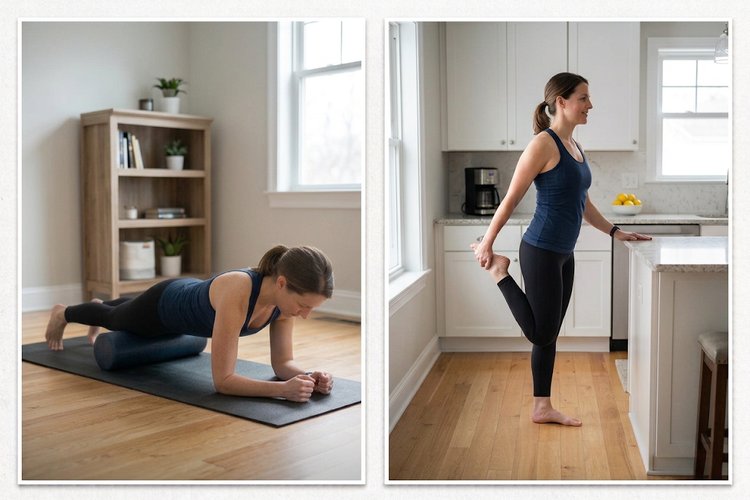
- Roll the quads: 1–2 minutes per leg, slowly, pausing on tender spots. Give extra time to the inner quad just above the knee.
- Roll the outer thigh and calves: The research is mixed on how much rolling changes the IT band itself, but working the muscles around it usually leaves the whole area feeling looser.
- Stretch the quads: Standing, holding a counter for balance, 30 seconds per side.
- Stretch the calves: Hands on a wall, back leg straight, 30 seconds per side.
Keep the pressure firm but tolerable, and roll the muscle — not directly on the kneecap or tendon.
Strength Through the Full Range
Loosening the tissue is half the equation. The other half is strength. Strong quads, hamstrings, glutes, and calves share the load so the joint doesn’t have to carry it alone.
I am a believer in training the legs through their full range of motion once a client is ready: squats, including deep squats; forward, reverse, and lateral lunges; step-ups; and, for the right person, light plyometric work like small controlled hops. Machines have their place too. The leg press, leg extension, and leg curl let us strengthen the same muscles in a controlled, easy-to-learn way — especially early on, or on a day the knee is cranky.
The key words are “once a client is ready.” We build up to depth and complexity. We never start there.
The Myth | What’s Actually True |
“Deep squats ruin your knees.” | Done with good form and built up gradually, full-range squats strengthen the muscles that protect the knee. |
“If my knee hurts, I should rest it.” | A short break during a flare-up is fine. Long-term avoidance weakens the knee’s support system and usually makes things worse. |
“Knee pain means the joint is damaged.” | Often the pain comes from tight or weak muscles around the knee — which is very workable. |
“After knee surgery, strength training is off the table.” | A repaired knee needs strength more than ever. It just has to be rebuilt systematically. |
“Only surgery helps arthritic knees.” | Soft-tissue care and appropriate strength work reduce pain and improve function for many people with arthritis. |
Based on principles from the American College of Sports Medicine (ACSM) and National Strength and Conditioning Association (NSCA) guidelines on exercise for special and clinical populations.
Years After the Injury: Old Repairs, Arthritic and Replaced Knees
Many of my clients tore an ACL, PCL, or meniscus decades ago, had it surgically repaired, went through therapy, and moved on with life. Life got busy. The strength that therapy rebuilt slowly faded, and now, in their 50s and 60s, the knee is aching again. Usually the repair hasn’t failed — the muscles supporting it have quietly let go.
The same is true for arthritic knees, and increasingly for knee replacements. In every case the fear is understandable; nobody wants to hurt a knee that has already been through something. But the answer is not to stop moving. It is to rebuild, systematically: assess first, start with controlled work like bridges, machines, and supported step-ups, and add range and load only when the previous step is clean and pain-free. For a replaced knee, we work within your surgeon’s guidelines and pick up where your therapist left off, with the goal of confident stairs, easy chair rises, and comfortable walking.
Alignment and the Feet
Some knee issues trace back to structure: bow legs, knock knees, flat feet, or feet that roll inward (overpronation). These change how force travels up the leg, and the knee takes the brunt of it. You can’t change your bone structure, but you can do a lot around it.
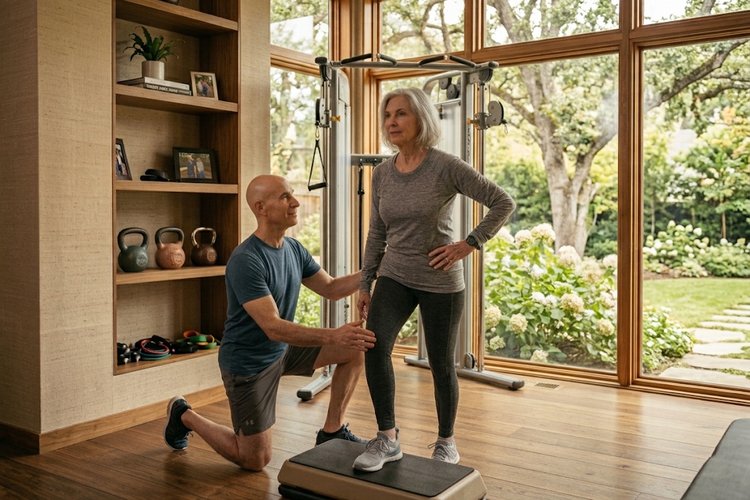
I look at how a client stands, walks, and squats. We strengthen the hips and glutes that control where the knee travels — more on that in the upcoming hip post — and work on foot and ankle strength and mobility. Footwear matters, too. For some people, a gait analysis and a change of sneaker — or, under the right supervision, an insert or orthotic — can make a real difference.
Where DynaFlex Fits In
If you read the series overview, you know every session I run includes my DynaFlex series. Much of it serves the knee directly: high knees, butt kickers, and backbend squats standing; bridging, knee grabs, and windshield wipers on the floor; bird dogs and isolated hip circles face up. Paired with a quad rollout, it loosens what’s tight, strengthens the glutes and hamstrings, and gets the knee moving well before any strength work begins.
You Have More Control Than You Think
don’t replace your doctor or physical therapist — I continue what they started. And if your knee is suddenly swollen, locking, or giving way, get it checked first. But for the everyday aches most people have learned to live with, there is a great deal you can do: roll it, stretch it, strengthen it, and progress it the right way.
If you are in Fairfield County and want help taking care of your knees — whether you’re preventing a problem or rebuilding after one — contact me here. We can start exactly where you are, gently, and at your pace.
Carlos Perez, M.S. holds a Master’s degree in Exercise Science (Human Performance) from Southern Connecticut State University and is ACE certified as both an Orthopedic Exercise Specialist and Senior Fitness Specialist. He has provided private, in-home personal training to professionals in Greenwich, Stamford, Westport, and Darien since 2006, specializing in safe, efficient strength training for adults ages 45–70.