Spring Reset: How to Build Real Strength at Home This Season
Spring has a way of waking people up. The days get longer, the weather turns, and suddenly that nagging feeling of “I really should be doing something” becomes impossible to ignore. If you’ve been walking regularly since our last post, you’ve already built a solid aerobic foundation. Now it’s time to add the next layer.
Strength training.
I want to be direct about something before we go further: strength training is not about lifting heavy, looking a certain way, or grinding through pain. Done correctly, it’s one of the most protective things you can do for your body — and one of the most empowering. It builds the physical resilience that keeps you active, independent, and injury-free for decades.
And you don’t need a gym to do it. After 20 years of providing in-home personal training across Fairfield County, I’ve helped hundreds of adults build real, lasting strength in their living rooms, spare bedrooms, and backyards. This post will show you exactly how to start.
Why Spring Is the Ideal Time to Start Strength Training
Most people think of January as the time to start a fitness program. But spring is actually a far better entry point — and there’s a physiological reason for that.
Longer daylight hours naturally increase serotonin levels, which improves mood, motivation, and energy. You’re more likely to follow through on a new habit when your baseline energy is higher. Spring also creates a natural deadline — summer is coming, and with it more activity, travel, and physical demand on your body. Starting a strength program now means you’ll be stronger, more capable, and more resilient by the time you need it most.
For my clients in Greenwich and Stamford, spring also means golf season, tennis season, hiking, and weekend activities with family. Strength training is what keeps you doing those things without getting hurt.
Trainer’s Note: The clients I see make the fastest progress are the ones who start in spring. They build a foundation over 10–12 weeks and by summer they’re moving better, feeling stronger, and wondering why they waited so long. |
What Strength Training Actually Does for Your Body
The research on resistance training is remarkably consistent. According to the American College of Sports Medicine, adults should perform muscle-strengthening activities at least two days per week. The National Strength and Conditioning Association further notes that resistance training is one of the most effective interventions for preserving muscle mass, bone density, and functional independence as we age.
Here’s what a consistent, well-designed program actually delivers:
• Muscle preservation: Adults lose 3–5% of muscle mass per decade after 30 without resistance training. Strength work stops and reverses that trend.
• Bone density: Weight-bearing resistance exercise stimulates bone growth, reducing osteoporosis risk — especially important for women over 50.
• Joint protection: Stronger muscles absorb force that would otherwise stress your joints — knees, hips, and shoulders in particular.
• Metabolic health: Muscle tissue burns more calories at rest than fat tissue, supporting healthy weight management.
• Posture and core stability: Reduces the everyday aches and pains that come from sitting, driving, and living a modern life.
• Confidence and independence: The ability to carry groceries, climb stairs, get off the floor — these matter more than most people realize until they start to go.
As Harvard Health Publishing notes, strength training builds more than muscles — it protects your long-term health in ways that no other form of exercise can replicate.
What You Actually Need to Get Started
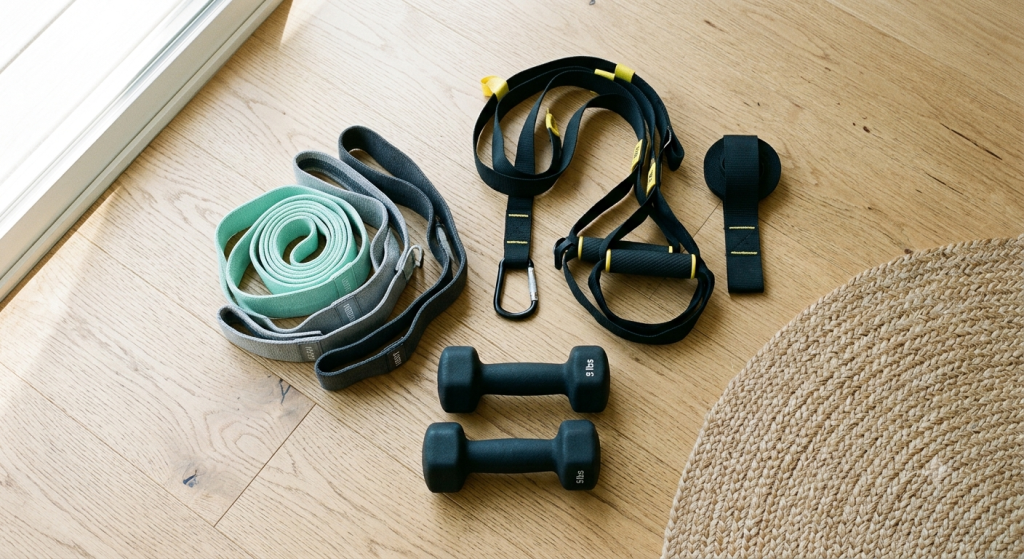
One of the most persistent myths about strength training is that you need a fully equipped gym. You don’t. Here’s what I recommend for a complete home setup — in order of priority:
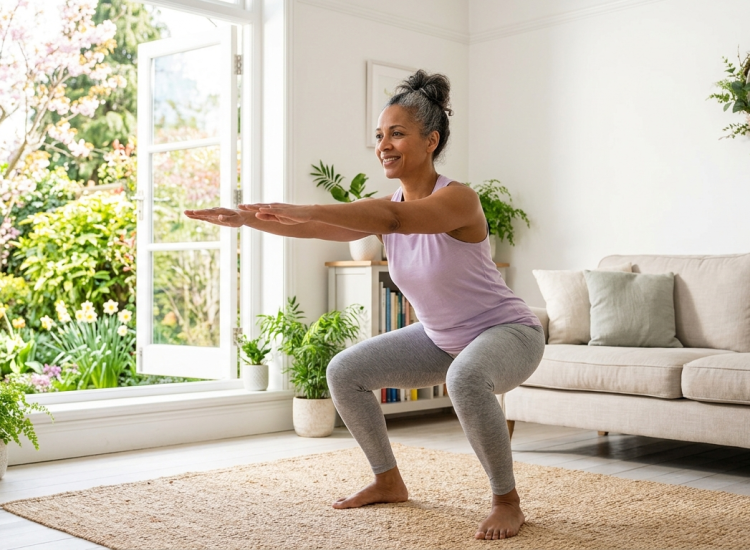
- Your own bodyweight — start here. Squats, wall push-ups, glute bridges, and planks are more than enough to build a solid foundation. Master these before adding any external resistance. Your body is a remarkably effective training tool.
- Resistance bands — the best investment in home fitness. Light, inexpensive, and portable. A set with multiple tension levels gives you everything you need for upper body, lower body, and core work. Joint-friendly and ideal for anyone with a history of orthopedic issues.
- TRX suspension straps — a one-time investment that opens hundreds of options. They attach to a door, wall anchor, or ceiling mount and use your bodyweight at different angles to make exercises easier or harder simply by adjusting your foot position. I use TRX regularly with clients of all fitness levels.
- Light dumbbells (5–15 lbs) — useful down the road, not essential to start. Build your foundation first. Add dumbbells when your bodyweight exercises feel genuinely easy.
Pro Tip: Don’t wait until you have the perfect setup to start. A resistance band and enough floor space to lie down is all you need for a complete and effective workout. |
A Spring Starter Routine to Build From
The following routine uses bodyweight, resistance bands, or TRX — whichever you have available. Perform one set of each exercise, rest 30–60 seconds, and repeat for up to three rounds. The most important thing: move slowly and deliberately on every rep. A 2-second lift and 3-second lower is far more effective than rushing. We covered exactly why in our recent post on time under tension.
Exercise | Equipment | Muscles Worked | Reps / Time |
Wall Push-Ups | Bodyweight | Chest, shoulders, triceps | 8–12 reps |
Chair Squats | Bodyweight | Legs, glutes, core | 10–15 reps |
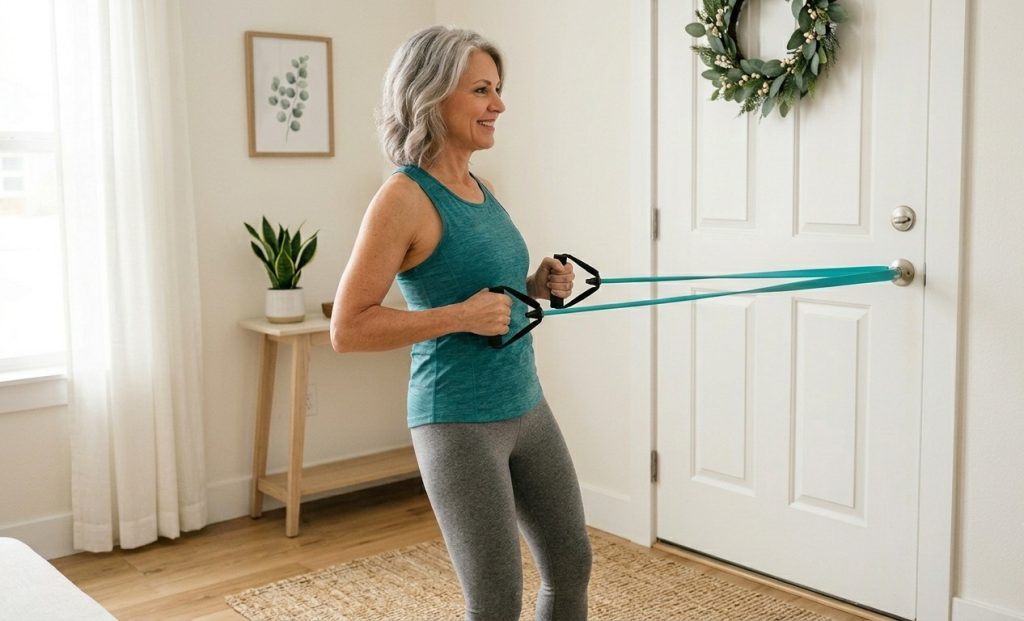
Band Rows | Resistance Band | Upper back, posture | 10–15 reps |
Glute Bridges | Bodyweight | Glutes, core, hips | 10–12 reps |
TRX Assisted Squats | TRX Straps | Full body, balance | 8–10 reps |
As the exercises begin to feel manageable, progress by adding 2–3 reps, an additional round, or slightly more band resistance. Never add load at the expense of form. We’ll cover progression in detail in next month’s blog.
Training Safely — The Principles I Build Every Program Around
Client safety is my absolute top priority. These are the same principles I apply with every client I work with, from beginners to experienced athletes:
- Always warm up first. Five minutes of light walking or gentle movement prepares your joints and muscles. Don’t skip this step.
- Start lighter than you think you need to. Finishing a workout feeling like you could have done more is not weakness — it’s wisdom. Soreness that prevents you from training for three days is counterproductive.
- Pain is a stop sign, not a speed bump. Muscle fatigue is normal and expected. Sharp pain, joint pain, or anything that doesn’t feel right means stop immediately and reassess.
- Control the movement — especially the lowering phase. As we discussed in our post on momentum and controlled movement, the lowering phase is where most people rush and where most injuries happen. Own every inch.
- Rest between sessions. Muscle is built during recovery, not during training. Allow at least one full day between strength sessions. Two to three sessions per week is ideal.
- Exhale during the effort, inhale during the return. Never hold your breath during a rep.
How to Fit This Into Your Week
Two to three strength sessions per week is the ideal starting point — enough to drive adaptation, not so much that recovery suffers. Here’s a simple weekly structure that pairs beautifully with the walking program we covered last month:
- Monday / Wednesday / Friday: Strength training — 20 to 30 minutes
- Tuesday / Thursday: Walking or light mobility work — your spring walking routine fits perfectly here
- Weekend: Rest, or whatever activity you enjoy — tennis, golf, hiking, a leisure walk with the dog
Twenty to thirty minutes is enough. Consistent shorter sessions performed with good form and real intention will always outperform sporadic longer workouts. Show up, do the work, recover, repeat.
The Bigger Picture
Building strength is not just about your muscles. It’s about maintaining your independence, protecting your joints, feeling capable and confident in your daily life, and investing in a body that will serve you well for decades.
I’ve watched clients in their 60s and 70s go from struggling with stairs to hiking trails. I’ve seen people who hadn’t exercised in years discover they were far more capable than they thought — they just needed the right starting point and the right guidance.
Spring is that starting point. The weather is cooperating, your energy is returning, and the foundation you build over the next 10 weeks will carry you through summer and beyond. Consistency over intensity. Patience over perfection. Show up twice a week and trust the process.
Ready to Build Your Spring Strength Program?
If you’d like personalized guidance building a safe, effective routine tailored to your body and your goals, I’d love to help. I’ve been providing in-home personal training in Greenwich, CT and throughout Fairfield County for over 20 years — working with busy professionals, active adults over 50, and anyone who wants to feel stronger and more capable in their daily life.
👉 Schedule a free consultation: Book here via Calendly — no commitment, just a conversation about your goals and how to get there.
Also in this series: Walking for Fitness in Greenwich This Spring
Carlos Perez, M.S. holds a Master’s degree in Exercise Science (Human Performance) from Southern Connecticut State University and is ACE certified as both an Orthopedic Exercise Specialist and Senior Fitness Specialist. He has provided private, in-home personal training to professionals in Greenwich, Stamford, Westport, and Darien since 2006, specializing in safe, efficient strength training for adults ages 45–70.