Why Rep Count Alone Is Misleading — And What Actually Drives Results
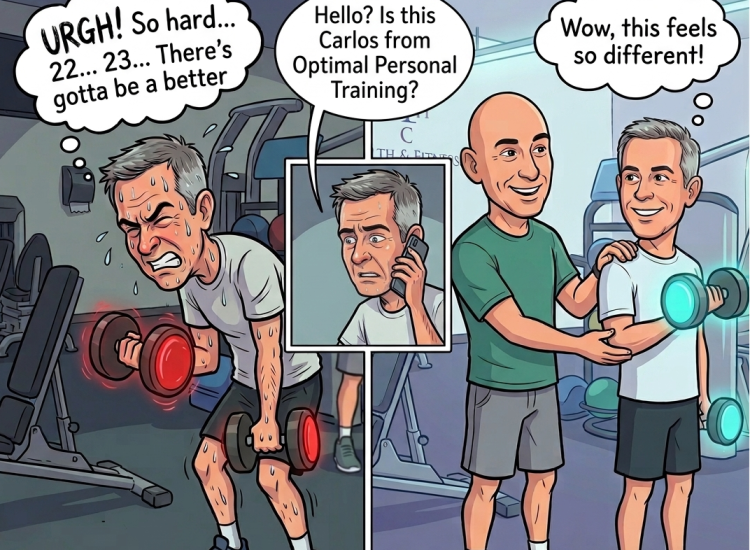
Finishing 12 reps should leave your muscles fatigued and pumped with blood — not wondering if you did anything at all. If you’ve ever completed a set and thought, “That’s it? I barely feel anything,” you’re not alone.
It’s one of the most common training mistakes I see — and it happens to smart, motivated people who are simply following the wrong metric. Most exercise programs tell you to do 3 sets of 12. So you do 3 sets of 12. But if those 12 reps fly by in 10 seconds using momentum, your muscles never got the chance to really work. No blood flow, no real fatigue, no meaningful stimulus. Just motion without purpose.
And beyond the lackluster results, rushing through reps with momentum puts unnecessary stress on your joints — something that matters a great deal if you’re over 50 and training for the long term.
After 20 years of providing in-home personal training in Greenwich and Stamford, I can tell you this: how long your muscles are under tension matters far more than how many reps you complete. Let me explain why.
Why This Mistake Is So Common
Generic fitness programs — the kind you find online or in magazines — are built around rep counts because they’re simple and universal. ‘3 sets of 10’ is easy to write, easy to follow, and easy to track. The problem is that rep count tells you nothing about how the reps were performed.
When people train on their own without feedback, the natural tendency is to find the path of least resistance — which usually means speeding up. A faster rep feels like more work because your heart rate rises, but your muscles are actually doing less work. Momentum is absorbing the load that your muscles should be handling.
This is exactly why personalized coaching makes such a difference. A good trainer doesn’t just count your reps — they watch your tempo, your control, and whether your muscles are actually fatiguing within the set.
The Real Driver: Time Under Tension
Here’s what the research shows: your muscles respond to the total time they spend working against resistance during a set — not simply the number of repetitions. This concept is known as Time Under Tension (TUT), and it’s one of the most important variables in effective strength training.
A study published in the Journal of Physiology found that slower, controlled repetitions produced greater muscle activation and metabolic stress than faster repetitions with the same load — both of which are key drivers of muscle development and strength gains.
Here’s the comparison I use with my clients:
Person A (Rep-Focused) | Person B (TUT-Focused) | |
Exercise | Bicep Curl | Bicep Curl |
Reps | 12 reps | 10 reps |
Set Duration | 15 seconds | 45 seconds |
Tempo | Fast, momentum-driven | Controlled, 2-3 sec each way |
Muscle Stimulus | Minimal — joints absorb load | High — muscles work entire set |
Result | Motion without purpose | 3x more muscle-building stimulus |
Person B is getting significantly more muscle-building stimulus, despite doing fewer reps. Their muscles worked three times longer under load. That’s the difference that shows up over weeks and months of training.
What the Numbers Actually Mean for Your Goals
Different training goals require different time ranges per set. Here’s a simple reference:
Goal | Time/Set | Weight | Real-World Example |
Strength & Power | 15–30 sec | Heavy (5–8 reps) | 5 slow squats, heavy load |
Muscle Building | 30–60 sec | Moderate (8–12 reps) | 10 controlled dumbbell rows |
Endurance & Tone | 60–90 sec | Lighter (15–20 reps) | 20 slow bodyweight squats |
When you rush through reps just to hit a number, you often cut the set time short and completely miss your actual training goal. Someone trying to build muscle who blazes through 12 reps in 15 seconds is actually training in the strength range — and not even doing that well, because the load is probably too light.
Trainer’s Note: Most of my new clients are surprised to discover they need to drop the weight by 20-30% when they first slow down their tempo. That’s not a step backward — it’s a sign you’re finally making your muscles do the work. |
Understanding Tempo Notation
Serious training programs often use a four-number tempo code to prescribe exactly how to perform each rep. For example: 3-1-2-0 means:
- 3 — 3 seconds on the lowering phase (eccentric)
- 1 — 1 second pause at the bottom
- 2 — 2 seconds on the lifting phase (concentric)
- 0 — no pause at the top before the next rep
That single rep takes 6 seconds. Ten reps at that tempo = 60 seconds of time under tension — right in the muscle-building sweet spot. Compare that to 10 fast reps done in 12 seconds total, and you can see the enormous difference in training stimulus.
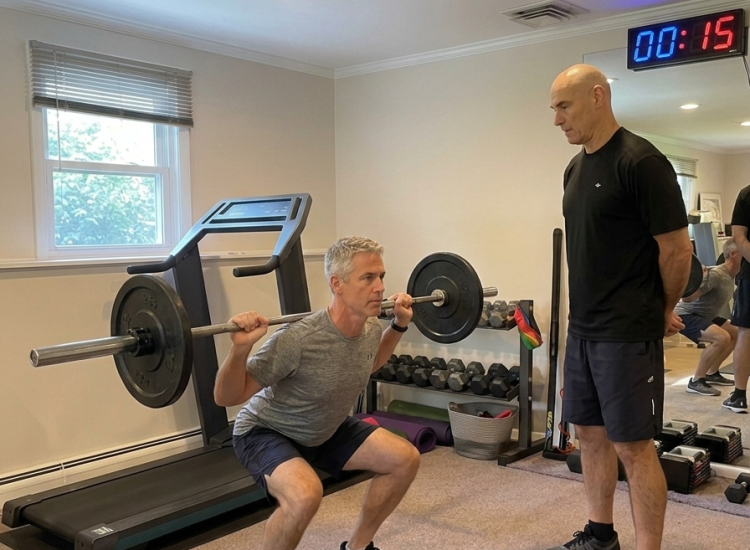
You don’t need to memorize tempo codes to benefit from this concept. Simply counting “two seconds up, two seconds down” on every rep will transform the quality of your training immediately.
How to Apply This in Your Next Workout
Next time you train, try this simple test:
- Pick an exercise you do regularly — a squat, a row, a chest press.
- Use a timer or count slowly: 2–3 seconds lifting, 2–3 seconds lowering.
- Aim for 40–60 seconds of total set time for general fitness and muscle building.
- Adjust your weight so you reach near-fatigue within that time window — not before, not after.
- Note how different it feels compared to your normal pace. That burning, fatigued sensation is your muscles actually working.
You may need to drop the weight slightly at first. That’s completely normal and expected. The goal is controlled tension — not just moving weight from point A to point B.
Pro Tip: The eccentric (lowering) phase is where most people shortchange themselves the most. Lowering a weight slowly is actually harder than lifting it — and research consistently shows the eccentric phase produces the greatest muscle-building stimulus. Never drop or rush the lowering portion of any rep. |
The Bottom Line
Rep count is a useful guideline, but it’s not the whole picture. Focus on controlled movement and appropriate set duration for your goals, and you’ll see better results with less risk of injury — regardless of how many reps you complete.
This is exactly why working with a qualified trainer makes such a difference. A generic program can tell you to do 3 sets of 12. A personalized program — built around your tempo, your form, your body, and your goals — can tell you why and how to do those 12 reps in a way that actually changes your body.
Ready to Train Smarter?
If you’d like to experience what truly intentional, personalized strength training feels like, I’d love to connect. I’ve been providing in-home personal training in Greenwich, CT and Fairfield County for over 20 years, working exclusively with adults who want safe, efficient, results-driven training.
👉 Schedule a free consultation: Book here via Calendly — no commitment, just a conversation about your goals.
Also worth reading: Walking for Fitness in Greenwich This Spring — the first post in our six-part fitness series.
Carlos Perez, M.S. holds a Master’s degree in Exercise Science (Human Performance) from Southern Connecticut State University and is ACE certified as both an Orthopedic Exercise Specialist and Senior Fitness Specialist. He has provided private, in-home personal training to professionals in Greenwich, Stamford, Westport, and Darien since 2006, specializing in safe, efficient strength training for adults ages 45–70.