How Momentum Is Secretly Hurting Your Workouts — And How to Fix It
You’ve probably seen it — someone at the gym swinging dumbbells up with their whole body, bouncing a barbell off their chest, or jerking a cable stack with a full-body heave. They’re working hard. Their heart rate is up. They’re sweating. But their muscles? They’re barely involved.
Here’s the thing — the same mistake happens just as often in home workouts, and it’s even harder to catch without a mirror or a coach watching. You pick up a weight, you move it from point A to point B, and you count the rep. But if momentum did most of the work, you’ve shortchanged your muscles and loaded your joints with forces they were never designed to handle repeatedly.
After 20 years of providing in-home personal training in Greenwich and Fairfield County, I’ve seen this pattern in nearly every new client I work with — regardless of their fitness level or experience. It’s not laziness. It’s simply a habit that develops when nobody’s ever explained why it matters.
This post will change that.
What Momentum Actually Does to Your Training
Momentum is the tendency of a moving object to keep moving. In strength training, that means once you get a weight swinging, physics takes over — and your muscles get to coast through the hardest part of the movement.
Muscles only grow stronger when they’re forced to work through the full range of motion under control. The initial contraction — that first inch of movement against resistance — is where real strength gets built. When you use a heave or a swing to get the weight moving, you skip past exactly that moment. The muscle never has to generate maximum force. It just catches a moving weight and guides it along.
And all that swinging and jerking? It transfers load directly to your joints, tendons, and ligaments — structures that are not designed to absorb that kind of repeated stress. Research published in the Journal of Strength and Conditioning Research has consistently linked poor movement control during resistance training to increased rates of shoulder, elbow, and lower back injury — some of the most common complaints I hear from new clients who’ve been training on their own.
Trainer’s Note: Most joint pain that people attribute to ‘getting older’ is actually the accumulated result of years of momentum-driven training. The joints took the beating the muscles were supposed to take. The good news — it’s completely correctable. |
Why This Happens — Even to Experienced Exercisers
Momentum creep is almost always an ego problem — but not in the way you might think. It rarely starts with someone consciously deciding to cheat. It starts with a weight that made sense three months ago but has become slightly too heavy now that fatigue has set in. Rather than reduce the weight, the body naturally finds assistance — a slight rock of the torso, a small swing of the elbow, a bounce at the bottom of a squat.
Online fitness content makes this worse. The most popular workout videos are full of fast, dynamic movement that looks impressive on camera. Slow, controlled training doesn’t get views. So most people have never actually seen what properly controlled strength training looks like — and they model what they’ve seen.
This is one of the most valuable things a good coach provides — not a program, but a mirror. Someone to say “slow down, feel that, now do it again.”
The Signs You're Using Too Much Momentum
Watch for these red flags in your own training:
- You have to ‘reset’ between reps — gathering yourself to heave the next one rather than flowing smoothly through the set
- The weight moves faster in some parts than others — flying through the middle, slowing at the ends
- Your body shifts or sways to get the weight moving at the start of each rep
- You can’t pause at any point and hold the weight steady — if stopping mid-rep causes a collapse, momentum was doing the work
- You feel it more in your joints than your muscles after the set — aching elbows, shoulder impingement, lower back fatigue
- The set feels too easy until the very last rep — controlled training should produce gradual, building fatigue throughout
If any of these sound familiar, momentum is quietly stealing your results — and potentially setting you up for an injury down the road.
How Momentum Shows Up in Common Exercises
Here’s what to watch for — and how to fix it — in the exercises most of my clients do regularly:
Exercise | Momentum Sign | Controlled Fix |
Bicep Curl | Swinging elbow forward, body rocking back | Elbow pinned to side, 2 sec up / 3 sec down |
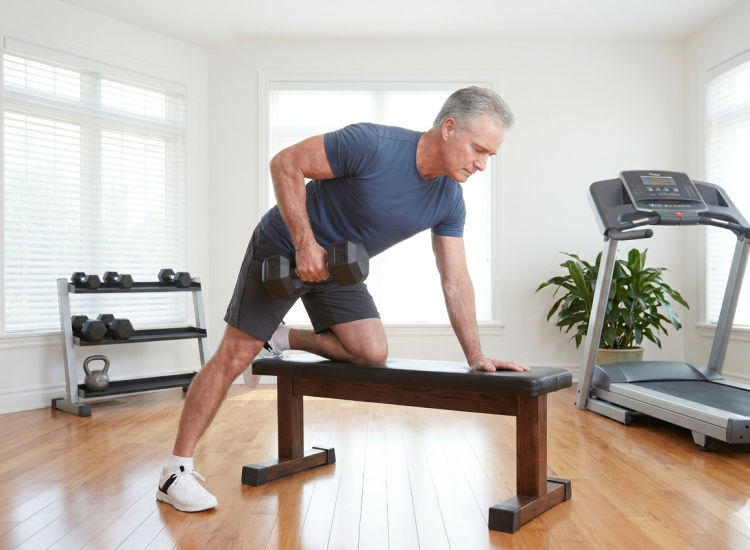
Dumbbell Row | Jerking weight up, torso rotating | Slow pull, pause at top, lower with control |
Chest Press | Bouncing weight off chest, rushing upward | 1 sec pause at chest, 2 sec press, 3 sec lower |
Squat | Dropping fast, bouncing at bottom | 3 sec descent, pause, controlled drive up |
Lateral Raise | Swinging arms up with body lean | Slow arc up, 2 sec hold at top, 3 sec lower |
Pro Tip: The pause test is the single best way to check your form on any exercise. At any point in the movement, can you stop and hold the weight completely still for 2 seconds? If not, the weight is too heavy or momentum is involved. This one check will immediately improve every exercise you do. |
How to Fix It — Starting Today
The solution is simple but requires discipline: slow down and own every inch of the movement. Here’s the exact approach I use with new clients:
- Lift for 2–3 seconds — no faster. Count it out loud if you need to.
- Lower for 3 seconds — this is where most people rush, and where most of the muscle-building stimulus lives. Never drop or release the weight.
- Pause briefly at each end — can you hold it there for a full second? If not, reduce the weight.
- Drop the weight 10–20% — your muscles don’t know how much is on the bar, only how hard they’re working. Lighter and controlled beats heavier and sloppy every time.
- Use tempo notation as a guide — a 3-1-2 tempo (3 seconds down, 1 second pause, 2 seconds up) keeps you honest on every single rep. We covered tempo in detail in our previous post on time under tension.
This connects directly to what we discussed in last month’s How-To post on time under tension — controlled movement and appropriate set duration work together. You can’t have one without the other.
What Controlled Movement Actually Feels Like
Many of my clients have a moment early in our work together where they drop the weight, slow down, and say “I can actually feel it now.” That’s the moment momentum is eliminated and the muscle takes over.
Here’s what you should experience with properly controlled reps:
- A deep, building burn in the target muscle — not a general exertion feeling
- Fatigue that builds gradually from rep 1 through the final rep
- The muscle feeling “full” and pumped after the set
- Far less joint discomfort during and after training
- A weight that feels surprisingly challenging despite being lighter than usual
That last point surprises people most. A 15-pound dumbbell moved with full control and a 3-second lowering phase is genuinely harder than a 25-pound dumbbell swung with momentum. The muscle doesn’t know how much weight is on the bar — it only knows how hard it’s working.

The Payoff — Why This Changes Everything
When you eliminate momentum from your training:
- Your muscles do 100% of the work — which is the entire point of strength training
- You’ll feel the target muscle working — not just general effort and elevated heart rate
- Joint stress drops significantly — less cumulative wear on shoulders, elbows, knees, and lower back
- You need fewer sets — quality reps produce more stimulus than high volume sloppy reps
- Injury risk decreases substantially — the leading cause of training-related injuries is uncontrolled load, not the load itself
- Results come faster — muscle responds to tension and time under load, both of which increase with controlled movement
This is especially important for adults over 45. We can absolutely build strength, add muscle, and transform our fitness — but we cannot afford to be reckless with our joints. Controlled movement is how you stay in the game for the long haul.
Ready to Train With Real Intention?
If you’ve been training for years but never had someone slow you down and show you what controlled movement actually feels like, you’re not alone — and you’re not too late. I work with adults in Greenwich, CT and throughout Fairfield County who want to train smarter, feel better, and stay injury-free for the long term.
👉 Schedule a free consultation: Book here via Calendly — no commitment, just a conversation about your goals and how to get there.
Also in this series: Why Rep Count Alone Is Misleading | Walking for Fitness in Greenwich This Spring
Carlos Perez, M.S. holds a Master’s degree in Exercise Science (Human Performance) from Southern Connecticut State University and is ACE certified as both an Orthopedic Exercise Specialist and Senior Fitness Specialist. He has provided private, in-home personal training to professionals in Greenwich, Stamford, Westport, and Darien since 2006, specializing in safe, efficient strength training for adults ages 45–70.