The Right Way to Progress Your Strength Training at Home
Introduction: The Power of Steady Progress
If you’ve been following along since our last article on gentle strength training at home, you may already be noticing small but meaningful changes — a little more energy, better posture, or movements that feel slightly easier than they did a few weeks ago. That’s not your imagination. That’s your body adapting.
And when your body adapts, it’s ready for more.
But here’s where a lot of people go wrong: they either stay stuck doing the same workout indefinitely, or they overcorrect and jump too far ahead too fast. Both paths lead to the same outcome — stalled progress or injury. The sweet spot is in the middle: small, deliberate, well-timed increases in challenge that keep your body improving without putting it at risk.
I’ve been working with clients across all fitness levels since 2006 — beginners, older adults, busy professionals, and people recovering from orthopedic issues. In my experience, knowing how to progress safely is the single most important skill in long-term fitness success. It’s also the one most people never get properly taught.
See previous post: Gentle Strength Training at Home

Why Your Body Needs Progressive Overload
There’s a foundational principle in exercise science called progressive overload — and it’s the backbone of any effective strength program. The idea is simple: your body only continues to improve when it’s given a slightly greater challenge than it faced before.
When you first start strength training, almost any stimulus produces results. Your muscles, tendons, and nervous system are encountering new demands and they respond quickly. But over time, your body becomes more efficient at handling that same workload. What felt genuinely hard six weeks ago now feels routine. That’s a sign of progress — and it’s also your signal that it’s time to make a change.
The American College of Sports Medicine (ACSM) recommends that adults perform strength training at least two days per week, progressing gradually in both volume and intensity to continue seeing meaningful adaptations. The National Strength and Conditioning Association (NSCA) echoes this, emphasizing that progression should be individualized — what works for one person may not be appropriate for another.
This is an important point. There is no universal progression timeline. A 55-year-old returning to exercise after a long break will progress differently than a 68-year-old who has been training consistently for two years. Your program should reflect your body, your history, and your goals — not a generic schedule.
The bottom line: if you’re not progressing, you’re maintaining at best — and more likely slowly regressing. The goal is a long-term upward trend, not a plateau.
5 Safe Ways to Add Intensity to Your Workouts
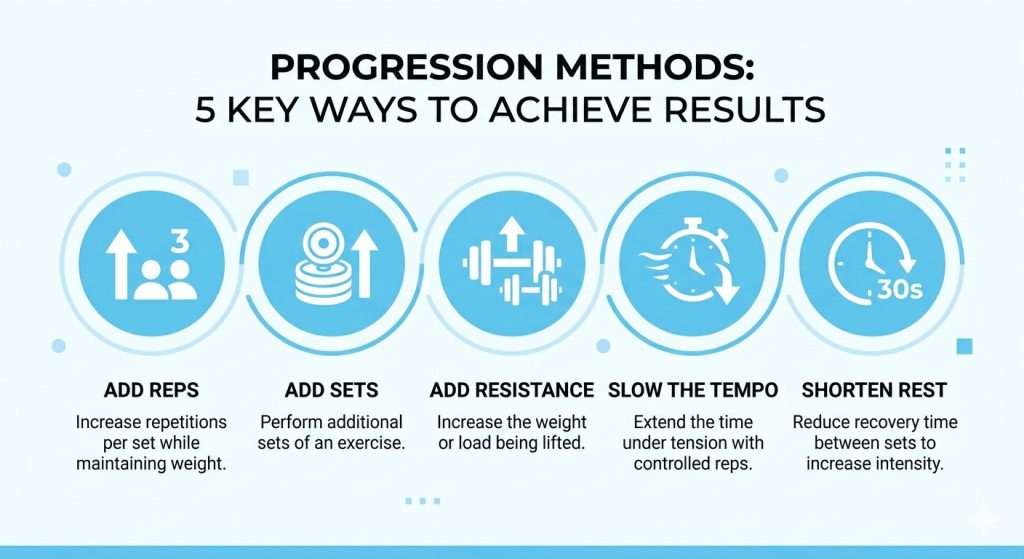
You don’t need to overhaul your routine to make meaningful progress. In fact, small adjustments are almost always more effective — and safer — than dramatic changes. Here are five methods I use regularly with clients at every level:
1. Add More Repetitions
If you’ve been doing 10 reps of an exercise comfortably, push to 12. This is the most gentle form of progression and the best place to start. Once 12 feels genuinely manageable across all your sets, that’s your cue to consider another adjustment. Think of it as earning the right to progress — comfort at the current level is your green light.
2. Increase Your Sets
Moving from one round to two rounds of your circuit significantly increases total training volume without changing the difficulty of any individual exercise. This is a particularly effective strategy early on, when building endurance and work capacity matters as much as raw strength. More total sets also means more total time under load — which drives adaptation.
3. Add Resistance
Switching to a thicker resistance band or moving up 2–5 pounds in dumbbell weight increases the load on your muscles directly. The key rule here is non-negotiable: only increase resistance when your form is solid at the current level. Adding load to a compromised movement pattern doesn’t make you stronger — it makes you more likely to get hurt. Form first, always.
4. Slow Down the Tempo
Performing exercises more slowly — especially during the lowering phase — dramatically increases time under tension, which is one of the most effective ways to build strength and muscle without adding any external load. Try a 3-second lowering phase on exercises like squats, wall push-ups, or glute bridges. You’ll feel the difference immediately, and your muscles will respond accordingly.
5. Shorten Your Rest Periods
Reducing rest from 60 seconds to 45 seconds between exercises challenges your cardiovascular system and forces your muscles to work with slightly less recovery. This is a subtle but powerful change that builds both endurance and mental resilience. It’s also a progression method that costs nothing and requires no equipment changes — just a timer and some discipline.
💡 Trainer’s Note: Change one variable at a time. Increasing reps AND sets AND resistance in the same week is too much, too fast. Pick one adjustment, give it 2–3 weeks, then consider the next. Patience here pays dividends. |
How to Know When You’re Ready to Progress
One of the most common mistakes I see — especially with highly motivated clients — is progressing before the body is ready. Enthusiasm is a wonderful thing, but more isn’t always better. Timing matters enormously.
You’re likely ready to increase the challenge when all of the following are true:
- Your last 2–3 reps feel comfortable, not challenging
- You recover fully within 24 hours after a session
- You can maintain perfect form through the entire set
- You feel energized, not exhausted, when the workout ends
- You’ve been doing the same routine consistently for at least 2–3 weeks
On the other hand, if you’re feeling persistently sore, fatigued, or losing form toward the end of your sets — that’s your body asking for more time to adapt, not a push forward. Respect those signals. Pushing through them is how minor fatigue becomes a real setback.
Common Mistakes to Avoid
After nearly two decades of training clients, I’ve seen the same progression mistakes repeat themselves. Here are the most common ones — and how to avoid them:
- Doing too much too soon. Doubling your weight or volume in a single week is a fast track to soreness, burnout, or injury. One adjustment at a time is the rule — no exceptions.
- Progressing without addressing form. If your technique isn’t clean at a lighter resistance, adding more load just amplifies the problem. A sloppy squat with a heavy band is far more dangerous than a clean squat with a light one.
- Skipping deload weeks. Every 4–6 weeks, reduce your intensity intentionally for one week. This gives your joints, tendons, and nervous system a chance to fully recover — and you’ll almost always come back stronger the following week.
- Comparing yourself to others. Your progression is yours alone. What matters is that you’re consistently a little better than you were last month — not how you stack up against anyone else in a class, on social media, or in your household.
- Neglecting the lower body. Many people gravitate toward upper body work and underestimate how important leg and hip strength is for everyday function, balance, and injury prevention — especially as we age.
Don’t Underestimate Recovery
Progress doesn’t happen during your workout — it happens after it. When you strength train, you’re creating small amounts of controlled stress in the muscle tissue. Rest is when your body repairs and rebuilds that tissue, coming back a little stronger each time. Skip the recovery, and you skip the results.
To support that process:
- Get at least one full rest day between strength sessions. Two to three sessions per week with rest days in between is the sweet spot for most adults.
- Prioritize sleep. The majority of muscle repair and hormonal recovery happens during deep sleep. Seven to eight hours is not a luxury — it’s part of your training program.
- Eat enough protein. Aim for 0.7–1 gram per pound of bodyweight as a general guideline. Protein provides the raw material your muscles need to rebuild after training.
- Stay hydrated. Even mild dehydration impairs muscle function, coordination, and recovery. This is especially relevant for active adults in warmer spring and summer months.
- Use rest days for gentle movement. Walking, light stretching, or the mobility work we’ll cover in the next post are all excellent ways to stay active without overtaxing your system.
Overtraining doesn’t accelerate results — it delays them. Some of the most effective programs I’ve designed for clients have been deliberately moderate in volume, with strategic lighter sessions built in to let the body peak. Less, done consistently and intelligently, beats more done haphazardly every time.
Consistency Is the Real Secret
In nearly 20 years of personal training, the clients who’ve made the most dramatic and lasting transformations weren’t the ones who trained the hardest. They were the ones who showed up consistently — even when motivation dipped, even when life got in the way, even when the workouts felt ordinary.
Progress in strength training is rarely a straight line. There will be weeks where everything clicks and you feel genuinely strong. There will also be weeks where you need to back off, reduce the load, or simply get through the session at a lower intensity. Both are part of the process. The goal isn’t perfection — it’s a long-term upward trend.
Spring is a particularly good time to build that consistency. The energy is higher, the days are longer, and the rhythm of the season supports new habits. The foundation you’re building right now — whether your goal is to carry groceries more easily, walk up stairs without losing your breath, stay competitive on the golf course or tennis court, or simply remain independent and active for decades to come — is built rep by rep, week by week, through steady and intelligent progression.
Ready to Progress — With a Plan Behind You?
Knowing what to change is only half the equation. Knowing when, how much, and in what sequence requires an experienced eye and a program built specifically for your body, your goals, and your history.
I offer in-home personal training throughout Fairfield County, CT — including Greenwich, Stamford, Westport, Darien, and Rye, NY — as well as online training via Zoom for clients anywhere in the country. If you’d like a program that grows with you safely and intelligently, I’d love to connect.
📞 Call or text: (203) 520-9886
📧 Email: [email protected]
👉 Next in the Series: Building Flexibility and Dynamic Mobility — The Missing Piece of Fitness
Carlos Perez, M.S. holds a Master’s degree in Exercise Science (Human Performance) from Southern Connecticut State University and is ACE certified as both an Orthopedic Exercise Specialist and Senior Fitness Specialist. He has provided private, in-home personal training to professionals in Greenwich, Stamford, Westport, and Darien since 2006, specializing in safe, efficient strength training for adults ages 45–70.