Flexibility and Dynamic Mobility: How to Move Better and Stay Resilient
Once you’ve built a foundation with walking and gentle strength training, the next essential piece of the puzzle is flexibility and mobility training. These are the elements that help your body move better, reduce stiffness, and support everything else you do — from your workouts to simply getting out of the car without thinking about it.
Flexibility and mobility are easy to overlook. They aren’t flashy, and they don’t leave you sore the next day. But after working with clients across all fitness levels since 2006 — beginners, older adults, busy professionals, and people recovering from orthopedic issues — I can tell you they’re often the difference between someone who stays active and confident into their later years and someone who slowly stiffens up and gives things up. Summer, with its longer days and natural pull toward being outside and active, is a perfect time to make these a real part of your routine.
If you’re just joining the series, you may want to start with how to progress your strength training safely — the foundation this article builds on.
Why Flexibility and Mobility Matter
Here’s the simplest way I explain it to clients: strength helps you move objects — mobility helps you move your body well.
When flexibility and mobility are limited, even simple movements — bending to tie a shoe, reaching for a high shelf, turning to check your blind spot — start to feel stiff or uncomfortable. Over time, that stiffness quietly increases your risk of aches, pains, and injuries. The good news is that this is highly reversible at any age, and it doesn’t take much.
Consistent mobility work helps:
- Improve joint range of motion
- Reduce stiffness and tightness
- Support better posture
- Enhance balance and coordination
- Make strength training and walking feel easier and safer
According to the Mayo Clinic, regular stretching helps improve flexibility, posture, and overall movement quality — and it’s one of the lowest-risk things you can add to a routine.
Flexibility vs. Dynamic Mobility
These two terms get used interchangeably, but they’re related rather than identical — and knowing the difference helps you use each one at the right time.
Flexibility
- Focuses on lengthening muscles
- Usually involves slower, held stretches
- Best used after workouts or on recovery days, when muscles are warm
Dynamic Mobility
- Uses controlled movement through a joint’s natural range of motion
- Ideal before a workout or a walk
- Prepares the body to move safely and reduces that first-few-minutes stiffness
Both matter, and they work best together — dynamic mobility to open things up before you move, gentle stretching to restore and recover afterward.
Simple Dynamic Mobility Exercises
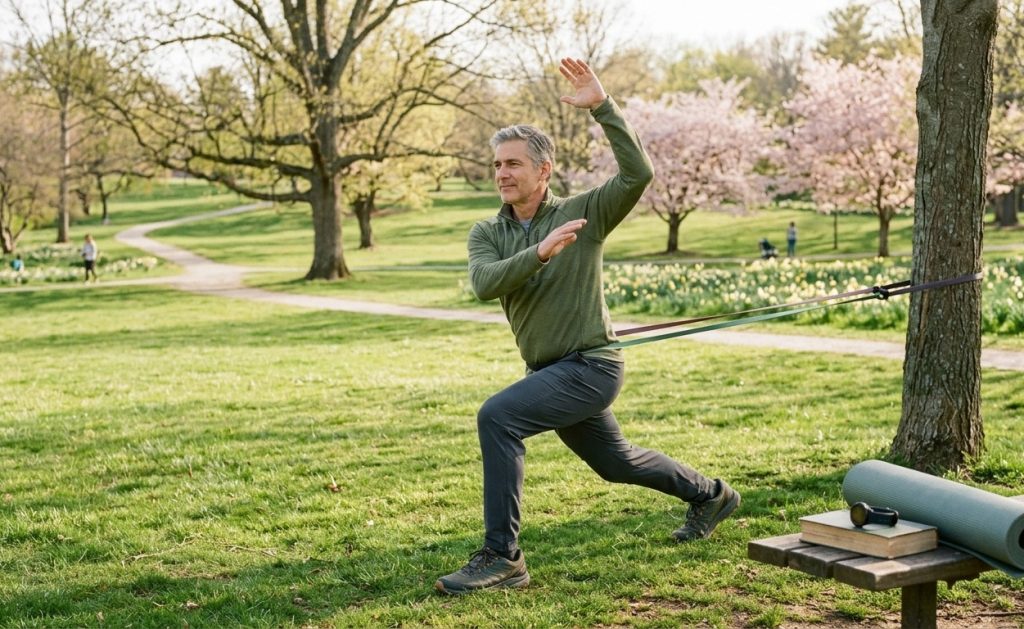
These gentle movements can be added before a workout or a walk. Keep everything slow, controlled, and pain-free — the goal is to wake the joints up, not to push into a stretch.
- Arm circles — to loosen the shoulders
- Hip circles — to improve hip mobility
- Torso rotations — to gently warm up the spine
- Leg swings — to prepare the hips and legs
Five to ten minutes of this is plenty. You should finish feeling looser and more ready to move, never fatigued.
A Gentle Introduction to Indian Clubs
One tool I’ve been incorporating with clients lately deserves a special mention here, because it fits this stage of fitness so well: Indian clubs.
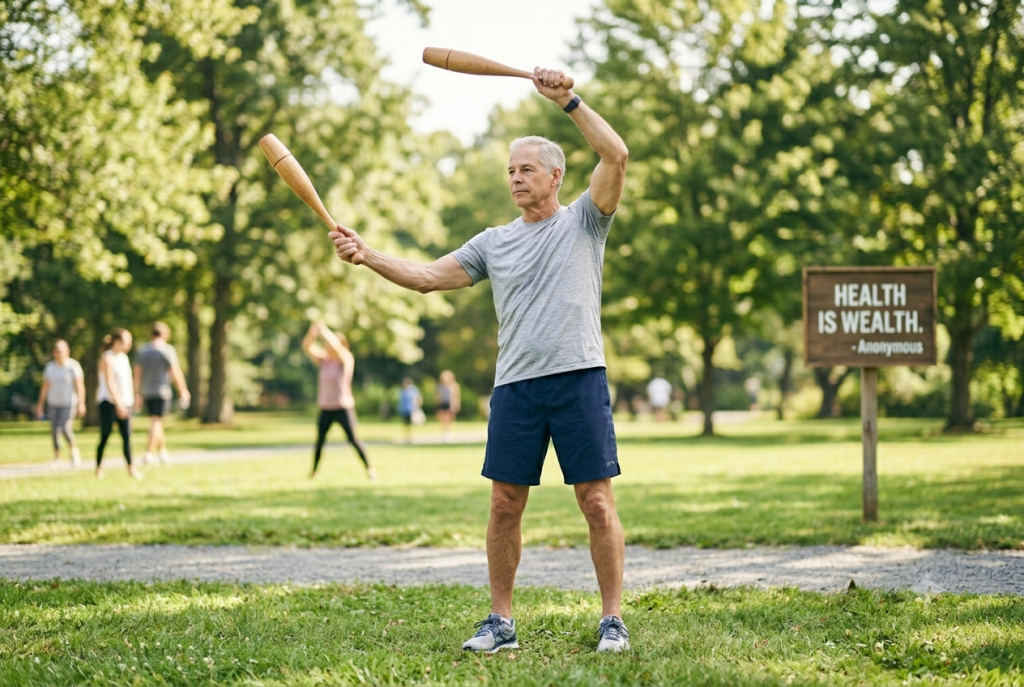
If you’ve never seen them, Indian clubs are small, bottle-shaped weights — often just one or two pounds — that you move in slow, controlled circular patterns, mostly around the shoulders and overhead. They have a long history as a mobility and conditioning tool, and they’ve quietly become a favorite of mine for one big reason: they’re exceptional for the shoulder.
The circular, swinging motions take the shoulder joint gently through its full range of motion under light, controlled load. That combination — movement plus a little resistance — does three things at once: it improves shoulder range of motion, it builds stability in the small stabilizing muscles around the joint, and it develops controlled strength without any heavy lifting. For a part of the body that tends to stiffen and lose range as we age, that’s a lot of value from a very light, very approachable tool.
This is also where the rotational, full-shoulder nature of the work pays off for anyone who plays a rotational sport. Golfers and tennis players, in particular, ask a tremendous amount of their shoulders and upper back, and I get genuinely excited about what these tools can do for them — better range of motion and a more stable shoulder translates directly to a smoother, safer swing or stroke. But you don’t have to be an athlete to benefit. Healthier, more mobile shoulders make everyday life — reaching, lifting, carrying — feel easier for everyone.
The most important part is how you start. I begin every client with the lightest possible load — a one-pound club — and sometimes with just a wooden handle and no weight at all, simply to groove the movement pattern first. The motions are gentle and the focus is always on control, never on how much you’re lifting. Done this way, it’s one of the safest additions you can make to a routine.
💡 Where this can go: For clients who build a solid foundation and want more, the natural next step is the steel mace — a longer, weighted tool used for similar swinging, rotational patterns at heavier loads. It’s a wonderful progression down the road, but it’s exactly that: a progression. We start light, master the movement, and earn our way there over time. |
Stretching for Recovery and Comfort
Stretching after exercise — or simply later in the day — helps release the tension that builds up from sitting, driving, and everyday life. It’s a small habit that pays off in how you feel.
Common areas worth focusing on:
- Hips and hamstrings
- Calves
- Chest and shoulders
- Lower back
Hold each stretch gently while breathing calmly. There’s no need to push or force anything — with stretching, consistency matters far more than intensity. A little, often, beats a lot, occasionally.
How to Add Mobility Into Your Weekly Routine
You don’t need long sessions to see real benefits. The key is simply making it a regular part of the rhythm of your week:
- 5–10 minutes of dynamic mobility before workouts or walks
- 5–10 minutes of stretching after workouts or in the evening
- A few minutes of gentle Indian club work, two or three times a week, once you’re comfortable
- Light daily movement on rest days — a short walk, some easy stretching
These small additions don’t feel like much on any given day. But over weeks and months, they’re what keep you moving freely and feeling capable.
The Big Picture
Flexibility and dynamic mobility are the connective tissue of your whole routine — they tie together the walking, the strength training, and the daily movement you’re already doing. They let your body move more freely, recover better, and stay resilient through everything summer has in store, whether that’s the golf course, the tennis court, a hike, or just keeping up with the people and activities you love.
And as you build that base of mobility and control, you set the stage for the next phase: adding a little controlled power and explosiveness, safely. That’s where we’ll go next.
Ready to Move Better?
If you’d like help building flexibility and mobility work — including a safe, gentle introduction to tools like Indian clubs — into a routine that fits your body and your goals, I’d be glad to help. I offer in-home personal training throughout Fairfield County, CT — including Greenwich, Stamford, Westport, Darien, and Rye, NY — as well as online training via Zoom for clients nationwide.
📞 Call or text: (203) 520-9886
📧 Email: [email protected]
👉 Next in the Series: Adding Gentle Power and Plyometrics to Your Program
Carlos Perez, M.S. holds a Master’s degree in Exercise Science (Human Performance) from Southern Connecticut State University and is ACE certified as both an Orthopedic Exercise Specialist and Senior Fitness Specialist. He has provided private, in-home personal training to professionals in Greenwich, Stamford, Westport, and Darien since 2006, specializing in safe, efficient strength training for adults ages 45–70.