The Squat at 50+: Why It Matters, How to Do It Right, and How to Get It Back
If there is one exercise that can preserve your independence, protect you from injury, and add functional years to your life, it is the squat. Not a machine. Not a leg press. The squat — a fundamental human movement pattern your body was built to perform.
Yet for many adults over 50, the squat has quietly disappeared. Tight hips, stiff ankles, achy knees, or simply never being taught properly have made it feel out of reach. The truth is, it almost certainly is not. And in this post, we will cover why squatting belongs in your routine, how to do it correctly, how to get it back if you have lost it, and how to modify it for real-world limitations.
After 20 years of providing in-home personal training in Greenwich and Stamford, I can tell you this: the squat is the single most important exercise I use with my 50+ clients — and the one most people have been told, incorrectly, that they can no longer do.
Why Lower Body Strength Changes Everything
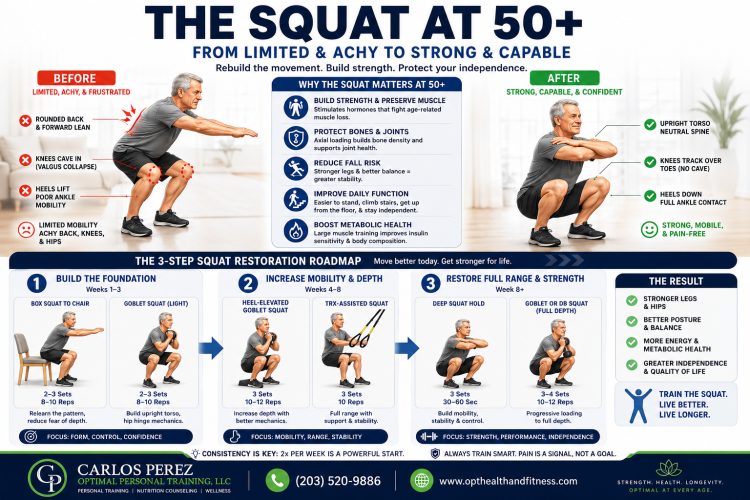
Your legs represent the largest muscle mass in your body. Training them does far more than build strong quads — it drives adaptations that benefit your entire physiology. Here is what the research consistently shows for adults in their 50s, 60s, and 70s:
- Hormonal response: Squats and other multi-joint lower body movements stimulate greater release of testosterone and growth hormone than any upper body exercise — critical for preserving muscle as we age.
- Bone density: Axial loading through the hips and spine during squatting is one of the strongest stimuli for maintaining bone mineral density and reducing fracture risk.
- Fall prevention: Strong quadriceps and glutes are among the most reliable predictors of fall resistance. Lower body weakness is directly correlated with fall risk in older adults.
- Functional independence: Rising from a chair, climbing stairs, getting up from the floor — all of these rely on the same mechanics as the squat. Train the movement, and daily life gets easier.
- Metabolic health: Large muscle group training improves insulin sensitivity, supports healthy body composition, and boosts resting metabolic rate.
The American College of Sports Medicine recommends resistance training targeting major muscle groups — including the legs — at least two days per week for older adults, citing measurable improvements in strength, function, and quality of life.
Squat Technique: The Key Elements
The squat is a coordinated, full-body movement. Done correctly, it is one of the safest exercises you can perform. Done incorrectly, it places unnecessary stress on joints that are already under pressure. Here are the non-negotiables:
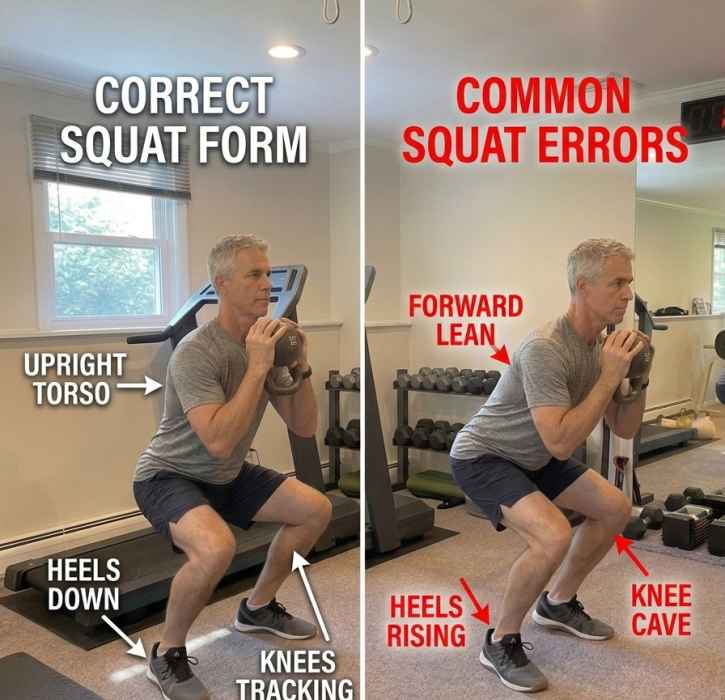
- Foot position: Shoulder-width or slightly wider, toes turned out 15 to 30 degrees to accommodate natural hip anatomy.
- Knee tracking: Knees must travel in the direction of the toes throughout the movement. Knees caving inward — known as valgus collapse — stresses the medial knee and must be corrected.
- Hip hinge initiation: Begin by pushing the hips back and down simultaneously, as if sitting toward a chair slightly behind you. Do not just bend the knees.
- Neutral spine: Maintain a natural curve in the lower back — neither rounded nor hyperextended — from start to finish.
- Heels on the floor: The heels must stay in full contact with the ground. If they rise, that is a mobility deficit, not a style choice, and it needs to be addressed.
The Heel Elevation Debate — And What the Science Says
You have likely seen people squatting with their heels elevated on a plate or wedge. This is one of the most discussed topics in strength training — and the answer is more nuanced than most people realize.
Why Ankle Mobility Is the Key Variable
To squat to parallel with good form, the ankle joint needs approximately 35 to 40 degrees of dorsiflexion — the ability of the shin to travel forward over the foot. For many adults over 50, this range is restricted due to years of elevated-heel footwear, calf tightness, Achilles stiffness, or arthritic changes in the ankle joint.
When the ankle cannot dorsiflex adequately, the body compensates: the heel rises, the torso pitches forward, and the knees often cave inward. These compensations, repeated over time, are what cause problems — not the squat itself.
When Heel Elevation Makes Sense
Elevating the heels 1 to 2 inches compensates for limited dorsiflexion and allows a more upright, deeper squat immediately. It is a smart, legitimate tool — especially for clients who need to train the pattern now while mobility work is ongoing. It is not a shortcut. Used correctly, it is part of a progression.
The Goal: Fix the Root Cause
Heel elevation should not be permanent if the underlying mobility can be improved. Consistent calf stretching, ankle joint mobilization, and myofascial release can meaningfully improve squat mechanics in 4 to 8 weeks. The goal is always to restore the mobility — not just work around it indefinitely.
The NSCA provides detailed guidance on squat technique and mobility considerations for strength and conditioning professionals.
Lost the Squat? Here Is How to Get It Back
This is the most important section if squatting feels impossible right now. A structured three-phase progression can rebuild the pattern safely at virtually any starting point. Use the table below as your roadmap.
Squat Restoration Progression — Phase by Phase
Phase | Exercise | Sets & Reps | Goal |
Phase 1 (Weeks 1–3) | Box Squat to Chair | 2–3 sets × 8–10 reps | Relearn pattern, reduce fear of depth |
Phase 1 (Weeks 1–3) | Goblet Squat (light) | 2–3 sets × 8–10 reps | Build upright torso, hip hinge mechanics |
Phase 2 (Weeks 4–8) | Heel-Elevated Goblet Squat | 3 sets × 10–12 reps | Increase depth, build confidence |
Phase 2 (Weeks 4–8) | TRX-Assisted Squat | 3 sets × 10 reps | Full range with counterbalance support |
Phase 3 (Week 8+) | Bodyweight Deep Squat Hold | 3 × 30–60 sec hold | Restore full mobility and stability |
Phase 3 (Week 8+) | Goblet or DB Squat, Full Depth | 3–4 sets × 10–12 reps | Progressive loading to full range |
Learn how we build these progressions for our clients across Fairfield County on our in-home personal training page and our Greenwich training services page.
Modifications for Common Limitations
Every client arrives with a different history. The squat can be adapted for nearly every common orthopedic limitation. Use this table as a quick reference:
Squat Modifications by Limitation
Limitation | Best Squat Variation | What to Avoid |
Knee Osteoarthritis | Box Squat to high surface, limited depth | Deep flexion past 90°, heavy loading |
Hip Replacement | Wide-stance squat within surgeon range | Deep hip flexion, internal rotation |
Lumbar Disc / Stenosis | Goblet Squat (front-loaded), TRX-assisted | Heavy barbell back squat, forward lean |
Balance Deficits | TRX or rack-supported squat | Unsupported single-leg loading too early |
Severe Ankle Restriction | Heel-elevated squat (permanent wedge) | Forced flat-foot squatting through pain |
For more on how we train clients with orthopedic limitations and chronic conditions, visit our Stamford personal training page or our Westport training services page.
The Long-Term Payoff
When adults over 50 commit to rebuilding the squat, the results go well beyond stronger legs. Improved posture, better metabolic health, and preserved independence are consistent outcomes. Research published in the Journal of Gerontology found that lower extremity strength training significantly reduced fall incidence in adults over 65 — one of the most consequential health outcomes in aging.
Perhaps most compelling: lower body strength is one of the strongest predictors of all-cause mortality in aging populations. Training these qualities is not just about fitness. It is training for a longer, more capable life.
Ready to Start?
The squat is not just an exercise. It is a measure of your physical capacity and a tool for preserving it. Losing the ability to squat well is not an inevitable part of aging — it is a signal that something needs attention. And with the right progression, it can be restored.
At Optimal Personal Training, we work with adults across Greenwich, Stamford, Westport, Darien, and Fairfield County to rebuild strength from the ground up. If you are ready to get started, contact us here. And explore our nutrition and wellness services to see how we address the full picture of healthy aging.
Carlos Perez, M.S. holds a Master’s degree in Exercise Science (Human Performance) from Southern Connecticut State University and is ACE certified as both an Orthopedic Exercise Specialist and Senior Fitness Specialist. He has provided private, in-home personal training to professionals in Greenwich, Stamford, Westport, and Darien since 2006, specializing in safe, efficient strength training for adults ages 45–70.