The Silent Thief: What Menopause Does to Women's Bones — and What Actually Rebuilds Them
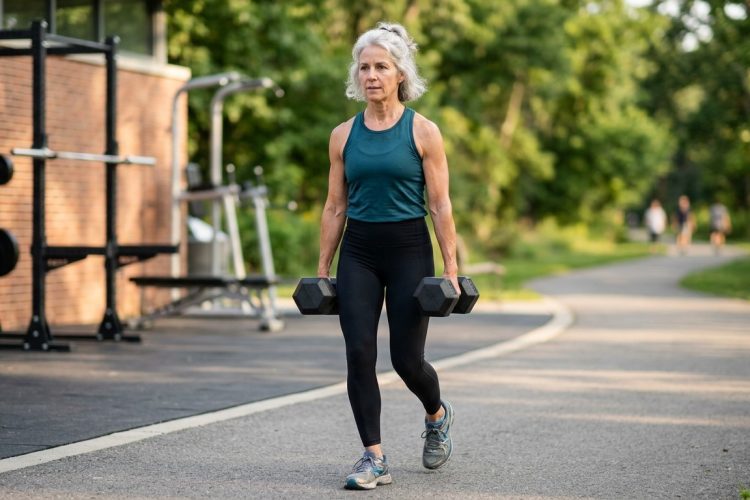
For nearly 20 years I have trained adults in their own homes across Fairfield County, and no topic comes up more often with my female clients in their 50s and 60s than their bones. Usually it arrives the same way: a routine DEXA scan comes back, the doctor says the word “osteopenia” or “osteoporosis,” and suddenly there is a prescription on the table and a lot of fear about a future of fractures. The questions that follow are almost always the same. How did this happen so fast? Is it too late? Do I really need the medication? And is there anything I can actually do about it myself?
This post is my attempt to answer all of that clearly. We will cover what these conditions actually are, why menopause hits women’s bones so hard, what the real numbers look like, which exercise and nutrition strategies genuinely move the needle (and which barely do anything), the role genetics plays, an honest look at the medications, and finally a comprehensive plan for the woman who has been told she needs to start treatment.
First, What Are Osteopenia and Osteoporosis?
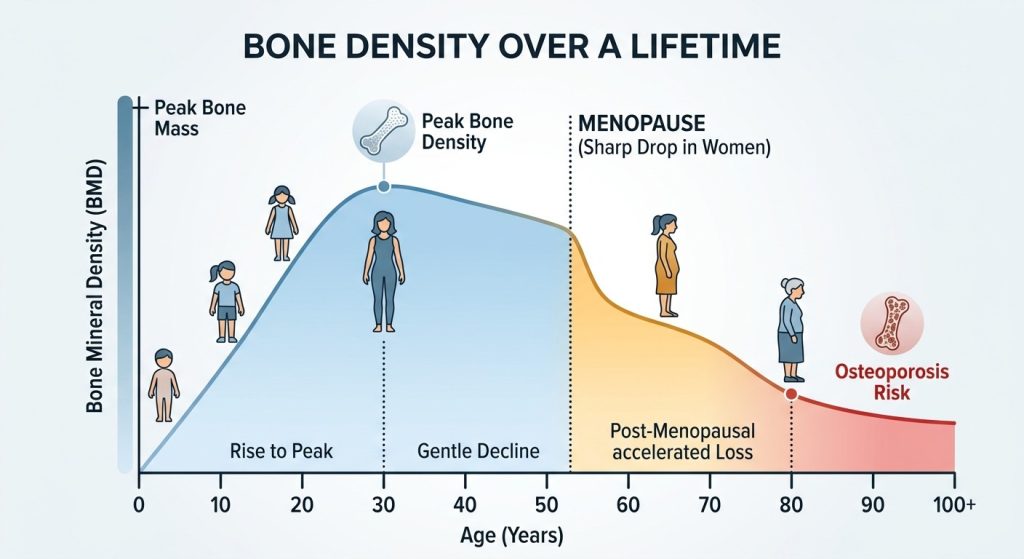
Bone is living tissue. Throughout your life it is constantly being broken down and rebuilt in a process called remodeling. In youth, building outpaces breakdown, and you accumulate bone until you hit peak bone mass somewhere around age 30. After that, the balance slowly tips the other way, and you begin a gradual net loss for the rest of your life.
Both conditions are diagnosed with a bone density scan (DEXA) that produces a T-score — a comparison of your bone density to that of a healthy young adult. The score defines where you fall:
Category | T-Score Range | What It Means |
Normal | -1.0 and above | Healthy bone density. |
Osteopenia | -1.0 to -2.5 | Lower than normal, but not yet osteoporosis. A warning zone. |
Osteoporosis | -2.5 and below | Significantly weakened bone; meaningfully elevated fracture risk. |
T-score criteria per the World Health Organization (WHO) diagnostic definition.
The key point: osteopenia is not a disease so much as a checkpoint. It is the body telling you the trajectory has turned. What you do during the osteopenia years largely determines whether you ever cross into osteoporosis at all.
Why Menopause Hits Women's Bones So Hard
Here is the mechanism that explains why this is so overwhelmingly a women’s issue. Estrogen is one of the most important protectors of bone in the body. It restrains the cells that break bone down (osteoclasts), keeping the remodeling process in balance. When estrogen falls off a cliff at menopause, that brake is released.
The result is dramatic. In the years immediately surrounding menopause and the first several years after, women can lose bone at a rate of roughly 2 to 3 percent per year — a pace far faster than the slow background loss of earlier decades. A woman can lose up to 20 percent of her bone density in the five to seven years around menopause. This is why a scan at 52 can look so different from one at 48, and why so many women feel blindsided. Men have no equivalent event; their testosterone declines slowly and steadily, which is a large part of why osteoporosis is far less common in men.
The Numbers: How Many People Does This Affect?
The scale of this is easy to underestimate. In the United States, roughly 10 million adults over 50 have osteoporosis, and about 43 million more have low bone mass (osteopenia) — meaning over 50 million Americans have compromised bone health. The gender split is stark.
Group | Osteoporosis | Low Bone Mass (Osteopenia) |
Women 50+ | ~8 million (about 1 in 5) | Roughly half of women over 50 |
Men 50+ | ~2 million (about 1 in 25) | ~16 million |
Overall (50+) | 1 in 8 adults | The majority of older adults have some loss |
Sources: figures compiled from U.S. prevalence data and the International Osteoporosis Foundation. Women’s osteoporosis prevalence over 50 is roughly four times that of men.
Two facts deserve emphasis. First, women carry roughly four times the osteoporosis burden of men, driven almost entirely by menopause. Second, the condition is dramatically underdiagnosed — a large share of cases, and an even larger share in men, are never identified until a fracture occurs. The consequences are not minor: a woman’s lifetime risk of an osteoporotic fracture is comparable to her combined risk of breast, ovarian, and uterine cancer, and hip fractures in older adults carry a sobering one-year mortality rate.
What Actually Works: Exercise for Bone
This is where I spend most of my professional life, and where the science is genuinely encouraging — but also where a lot of well-meaning advice is simply wrong. Bone follows a rule known as Wolff’s Law: it adapts to the loads placed on it. To build or preserve bone, you have to give it a reason. That reason is either heavy load or impact. Gentle, comfortable movement does very little. Let me be blunt about what the research actually shows, because it runs counter to a lot of common advice.
Strength Training — The Single Best Tool
Progressive, heavier resistance training is the most effective exercise intervention for bone, full stop. High-intensity strength training has been shown to increase bone density at the spine and hip in postmenopausal women, while low-intensity work does not. The load has to be meaningful — this is not light dumbbells for high reps. Exercises that load the spine and hips directly, done with proper form and progressive weight, are what stimulate bone to rebuild. Farmer’s carries are a personal favorite here: loading heavy weight and walking places substantial, safe compressive force through the entire skeleton, and they double as functional strength for real life.
Impact: Why Jogging Beats Walking (and Casual Walking Barely Counts)
This one surprises most people. Habitual walking at a comfortable pace (around 4 km/h) is not associated with meaningful bone density gains — it simply does not generate enough strain to trigger bone adaptation. It is wonderful for cardiovascular health and mood, but as a bone-building strategy it barely registers. What does work is impact and higher strain: jogging, brisk walking above roughly 5 km/h, stair climbing, and controlled jumping or hopping all generate the ground-reaction forces that stimulate bone at the hip and femoral neck. The catch is that high-impact work must be matched to the individual — hopping and jumping are powerful stimuli but carry real risk in someone who is already frail or has established osteoporosis, which is exactly why supervision matters.
Yoga, Vibration Plates, and Trampolines — An Honest Take
These come up constantly, so here is my straight assessment. Yoga is excellent for balance, flexibility, and fall prevention — and preventing falls is a genuinely important part of avoiding fractures — but it is not a strong direct bone-builder, because it does not load the skeleton heavily. Whole-body vibration platforms have some supportive evidence and may offer modest benefit, particularly for those who cannot tolerate high-impact work, but the effect is smaller than resistance training and the evidence is mixed. Mini-trampolines (rebounding) provide low-impact loading and are gentle on joints, which makes them a reasonable option for people who cannot jog, but they are a supplement, not a substitute for real resistance work. My honest summary: none of these should be your primary strategy, though they can be useful complements.
Strategy | Bone-Building Effect | Best Use |
Heavy resistance training | Strong | Foundation of any bone program. |
Farmer’s carries / loaded carries | Strong | Whole-body loading + real-world function. |
Jogging / brisk walking / stairs | Moderate–Strong | Impact stimulus for hip and spine. |
Vibration / rebounding | Modest / mixed | Supplement, or option when impact isn’t safe. |
Yoga | Minimal (direct) | Balance & fall prevention, not density. |
Casual walking | Very low | Great for health, weak for bone. |
Effect ratings synthesized from systematic reviews on exercise and postmenopausal bone mineral density.
The through-line is simple: load the bone or add impact. If you want to see how we structure safe, progressive strength work for this exact population, you can read more on our personal training services page, and how we work with clients across Greenwich, Stamford, and Westport.
Nutrition: The Raw Materials
Exercise gives bone the signal to build; nutrition provides the materials. The two big players are calcium and vitamin D — calcium is the mineral bone is made of, and vitamin D is what allows your body to absorb it. Most guidelines target around 1,000 to 1,200 mg of calcium daily for women over 50 (ideally from food first — dairy, leafy greens, sardines, fortified foods) alongside adequate vitamin D. Protein is the underappreciated third pillar: bone is roughly half protein by volume, and adequate protein intake supports both the bone matrix and the muscle that pulls on it. This matters especially for women trying to build bone through training — you cannot rebuild the structure without the raw material.
The larger lesson is about timing. The women who reach menopause with the strongest bones are the ones who built the most bone earlier in life, through years of good nutrition and weight-bearing activity in their 20s, 30s, and 40s. You cannot change your past, but the principle holds forward: the habits you keep now determine the bone you carry into your 70s and 80s. Our approach to eating for strength and healthy aging is covered on our nutrition page.
The Role of Genetics
It is fair to ask how much of this is simply out of your hands. The honest answer: genetics plays a substantial role. Peak bone mass — the amount of bone you banked by age 30 — is estimated to be 60 to 80 percent genetically determined. Family history matters too; a mother with a hip fracture measurably raises your own risk. Body frame plays in as well, with smaller, thinner-boned women at higher baseline risk.
But here is the crucial framing I give every client: genetics loads the gun, lifestyle pulls the trigger — and lifestyle can also put it back in the safe. Your genes set your starting point and your tendency, not your destiny. Two women with identical genetic risk can end up in very different places at 70 based on decades of training, nutrition, and whether they intervened when the first scan flagged a problem. The modifiable factors are powerful enough to matter enormously, which is precisely why the diagnosis is a call to action rather than a verdict.
The Medications: Benefits, Risks, and the Honest Picture
If your doctor has recommended medication, this section is meant to inform you, not to talk you out of anything — that is a decision between you and your physician. But you deserve to understand what is on the table. The most common drug classes are antiresorptives, which slow the cells that break bone down.
Medication | How It Works / Benefit | Key Risks & Side Effects |
Bisphosphonates (alendronate, risedronate, zoledronic acid) | Most-prescribed; proven to reduce spine, hip, and non-vertebral fractures. | GI irritation (oral); flu-like symptoms (IV); rare atypical femur fracture and jaw osteonecrosis with long-term use. |
Denosumab (Prolia) | Injection every 6 months; increases density and cuts fracture risk. | Rare atypical fracture and ONJ; rebound bone loss if stopped without a follow-up plan. |
Anabolic agents (teriparatide, etc.) | Actively build new bone; used for severe cases. | Injection-site pain, nausea, leg cramps, dizziness; time-limited use. |
Sources: International Osteoporosis Foundation; FDA adverse-event data. This is educational, not medical advice — discuss all options with your physician.
The balanced view most experts hold: for someone at genuine high fracture risk, the benefit of these drugs generally outweighs the risks, and the two most feared side effects — atypical femur fracture and jaw osteonecrosis — are genuinely rare. That said, they are real, they are associated mainly with long-term use, and they are a legitimate reason to ask your doctor about the plan for how long you will take the medication and what the exit strategy is. Medication and lifestyle are not an either/or. The strongest outcomes come from combining them: the drug slows loss while training and nutrition build the surrounding muscle, improve balance, and lower fall risk.
A Comprehensive Plan for the Woman Told She Needs Medication
Suppose you have just been told your T-score has crossed a line and a prescription is being suggested. Here is the comprehensive approach I would build with you — designed to work alongside whatever you and your doctor decide about medication, not instead of it.
Pillar | What It Involves |
1. Progressive strength training | 2–3 supervised sessions per week emphasizing heavy, safe loading of the spine and hips — squats, hip hinges, presses, rows, and loaded carries — progressed gradually with strict form. |
2. Targeted impact (as appropriate) | Brisk walking, stair work, and — only if suitable and cleared — light impact. Matched carefully to your current bone status and joint health. |
3. Balance & fall prevention | Because most fractures come from falls, dedicated balance work (and yoga’s real strength) directly lowers the risk that matters most. |
4. Nutrition | Adequate calcium (food-first), vitamin D, and — critically — enough protein to support both bone matrix and muscle. |
5. Medical partnership | Coordinate with your physician on medication and repeat DEXA scans to track progress objectively over time. |
6. Consistency over years | Bone remodels slowly. This is a multi-year commitment, not a 12-week fix — which is exactly why sustainable, supervised programming matters. |
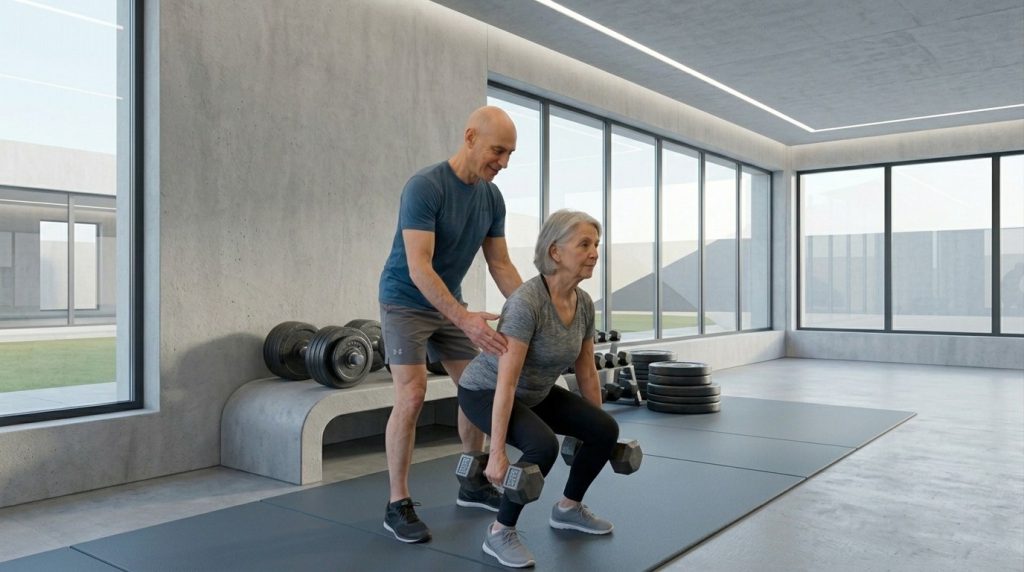
The reason I train this in person, especially early on, is safety. A woman with reduced bone density needs enough load to stimulate bone but not so much, or such poor form, that she risks the very fracture we are trying to prevent. That line is precisely where a qualified trainer earns their keep.
The Bottom Line
A scan that flags osteopenia or osteoporosis is not a sentence — it is information, and information you can act on. Menopause deals women a genuinely tough hand, and genetics sets the table, but the two most powerful levers you have — heavy, progressive strength training and proper nutrition — are entirely within your control. Whether or not you take medication, building muscle and loading your skeleton is what carries you into your later decades strong and independent.
If you are in Fairfield County, have been told your bone density is dropping, and want a safe, realistic program built around where you actually stand, contact us here. We work with women at every stage — from those getting ahead of the curve in their 40s to those turning things around after a diagnosis in their 60s and beyond
Carlos Perez, M.S. holds a Master’s degree in Exercise Science (Human Performance) from Southern Connecticut State University and is ACE certified as both an Orthopedic Exercise Specialist and Senior Fitness Specialist. He has provided private, in-home personal training to professionals in Greenwich, Stamford, Westport, and Darien since 2006, specializing in safe, efficient strength training for adults ages 45–70.