Why You Can Safely Swing a Mace (But Not a Dumbbell): The Science of Tendon Training
If you’ve spent any real time in a gym, you’ve heard the rule drilled into you: never swing your weights. Control the dumbbell. Don’t let momentum throw the barbell around. Slow and controlled protects your joints.
So here’s a question worth sitting with: if swinging weights is dangerous, why are steel maces and Indian clubs — tools built entirely around swinging through big arcs — considered some of the safest, most joint-friendly training available today?
After 20 years of providing in-home personal training in Greenwich and Stamford, I’ve built my entire approach around one non-negotiable: strict, safe, efficient movement. So when a training method built on momentum crossed my radar, I wanted to understand exactly why it works before I ever brought it to a client.
This isn’t entirely new territory for me, either. I played baseball through college, where we used a weighted “donut” that slid onto the bat, roughly doubling its normal weight, before stepping into the batter’s box. Swing something twice as heavy a few times, and the normal bat suddenly feels light and fast in your hands. Add in years of tennis and golf, both built on efficient, repeatable rotational swings, and it’s easy to see why the mace and Indian clubs caught my attention. The pattern was already familiar. What I wanted to understand was the science underneath it — and why it applies just as well to a 55-year-old client working on shoulder health as it does to an athlete warming up to compete. Here is what the science says.
The Swinging Paradox
The instinct that swinging is “bad” isn’t wrong — it’s incomplete. The danger in swinging a weight isn’t the swing itself. It’s the combination of three specific factors:
- Heavy load: A mass significant enough to generate real force.
- Long lever: Weight positioned far from the joint doing the work.
- Fast deceleration: The joint forced to suddenly stop that mass at the end of its range.
When you swing a heavy dumbbell, all three factors stack together. The shoulder, elbow, or wrist has to absorb that force right at end range — exactly where connective tissue is most vulnerable. That is the injury scenario, and it is why we coach control with traditional weights.
Change those variables, and swinging becomes not just safe, but genuinely beneficial. That is exactly what mace and club training does.
It's About Leverage and Load — Not the Swing Itself
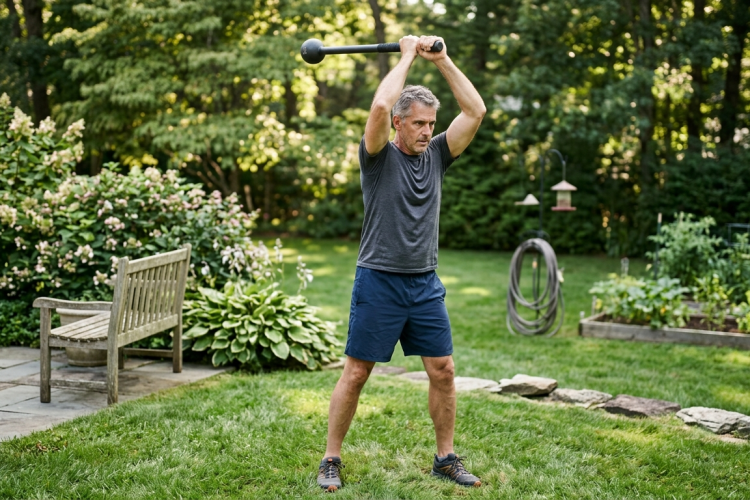
A steel mace places its weight far out at the end of a long handle. That long lever multiplies the training demand, which is the entire point — so the load itself stays light. A typical mace runs 7 to 25 pounds, but because the weight sits so far from the hands, it trains the body as if it were far heavier.
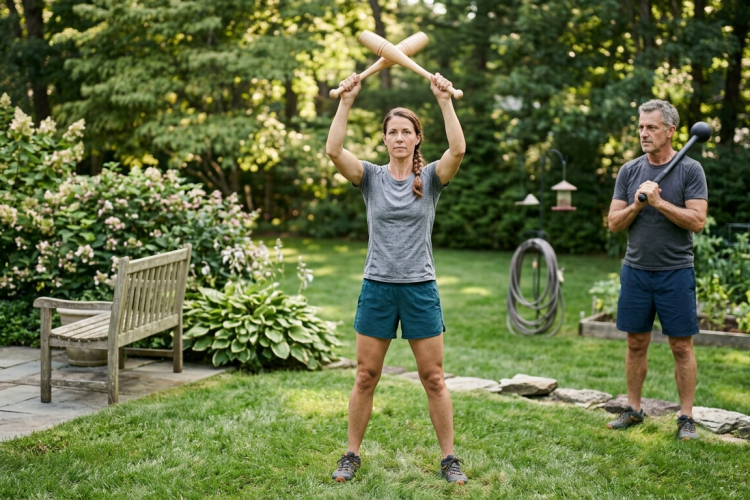
Indian clubs go further in the other direction. Often just 1 to 5 pounds, they are not a loading tool at all. They are a mobility and coordination tool, guiding the shoulders, elbows, and wrists through smooth, rhythmic, full-range arcs.
Kettlebells complete the picture. A kettlebell swing can move real load — 32 kilograms and beyond for trained athletes — but the mechanics are different. The weight stays close to the body, and the swing is driven by the hips, not the arms. Force routes through the hips and glutes, structures built to absorb it, while the arms function more like ropes than levers.
Compare all three to the dumbbell and barbell, where the muscle does the work through a controlled range and load can climb very high. Different tool, different job, different demand on the tissue. This is exactly the kind of layered programming I bring into sessions across Westport and the rest of Fairfield County — matching the right tool to the right training goal.
What Is Actually Happening in Your Tendons
This is the part of the picture most people never hear, and it is the part that matters most for training that lasts.
Muscle and connective tissue adapt to different qualities of load. Muscle responds well to high tension and volume. Tendons and the surrounding fascia respond best to rhythmic, through-range, oscillatory loading — repeated, controlled loading as the tissue moves across its full range of motion.
That is precisely what mace and club training delivers. Swinging a mace overhead through a large arc loads the tendons progressively across the entire range, not at a single fixed angle. The momentum creates a gentle traction demand at the end ranges, repeated over and over, without ever spiking into a danger zone — because the load is light and the movement stays rhythmic. That repeated, moderate, through-range loading is one of the most effective stimuli known for building tendon resilience and improving the force handoff between muscle and bone.
A heavy dumbbell, by contrast, loads the tendon hard but typically through a shorter, fixed-angle range. Excellent for building raw strength — but it does not train the tendon’s elastic, through-range capacity the same way. Add a swing to that heavy dumbbell, and you introduce a sudden high-velocity traction force on tissue that was never prepared to absorb it.
A quick clarification worth knowing: these tools are often described as “stretching the tendons.” That is a useful mental image, but technically inaccurate — a tendon that stretches easily is a weak tendon. What is actually improving is the tissue’s load tolerance and elastic efficiency through range, along with joint mobility and coordination. The mechanism is real; the phrasing is just a simplification.
Worth noting honestly: there isn’t dedicated research on maces or clubs specifically — this is still a fairly new tool in the mainstream strength world. What we do have is well-established tendon loading science. The continuum model of tendon pathology, developed by sports medicine researchers Cook and Purdam, is the foundational framework showing how tendons respond to graded, progressive load management — and it is the basis for the reasoning above. I use that same evidence-based approach with clients across Darien working through rehab or prehab goals.
Comparing the Four Tools
Tool | Primary Benefit | Typical Load | Tissue Emphasis |
Indian Clubs | Shoulder mobility, joint health, coordination | 1–5 lbs | Tendon and fascia mobility |
Steel Mace | Rotational strength, shoulder stability, core | 7–25 lbs (offset) | Tendon load tolerance through range |
Kettlebell | Power, hip drive, conditioning | Light to very heavy | Force absorption through the hips |
Dumbbell / Barbell | Raw strength, hypertrophy | Light to very heavy | Muscle tension and maximal strength |
Where This Fits in a Well-Built Program
None of these tools replace traditional strength work. They fill different roles entirely. The clubs and mace prepare and protect the joints. The kettlebell builds power through the hips. The dumbbell and barbell build the raw strength engine. A program that uses all four covers ground that no single tool can cover alone.
Good training evolves. The exercise world is enormous, and the trainers worth working with are the ones still learning after decades in the field. This is not a correction of what came before — it is the connective-tissue layer added on top of a foundation already built on control, safety, and sound mechanics. I am currently completing formal steel mace certification through KIPS Online as part of my ongoing continuing education, so this is being integrated the same way everything else in my programming is: deliberately, and with the evidence behind it.
A Natural Fit for Golf and Tennis
If you play golf or tennis, this training likely matters to you more than most. Both sports demand a powerful, repeatable rotational swing — and both put real, repeated stress on the shoulders, elbows, and wrists at the exact end ranges where the mace and clubs do their best work. Building tendon resilience through those same rotational patterns, at low load and in a controlled setting, is one of the more direct carryovers you’ll find between the gym and the course or court. It’s a big part of why I find this training so compelling for my own clients who play either sport.
Ready to Move Better?
Strong muscles move you. Resilient tendons keep you moving for life. If you’d like help building flexibility and mobility work — including a safe, gentle introduction to tools like Indian clubs or maces — into a routine that fits your body and your goals, I’d be glad to help. I offer in-home personal training throughout Fairfield County, CT — including Greenwich, Stamford, Westport, Darien, and Rye, NY — as well as online training via Zoom for clients nationwide.
 Call or text: (203) 520-9886
 Email: [email protected]
 Next in the Series: Adding Gentle Power and Plyometrics to Your Program
Carlos Perez, M.S. holds a Master’s degree in Exercise Science (Human Performance) from Southern Connecticut State University and is ACE certified as both an Orthopedic Exercise Specialist and Senior Fitness Specialist. He has provided private, in-home personal training to professionals in Greenwich, Stamford, Westport, and Darien since 2006, specializing in safe, efficient strength training for adults ages 45–70.