The Clock Is Ticking: How Aging Specifically Affects Your Body After 40
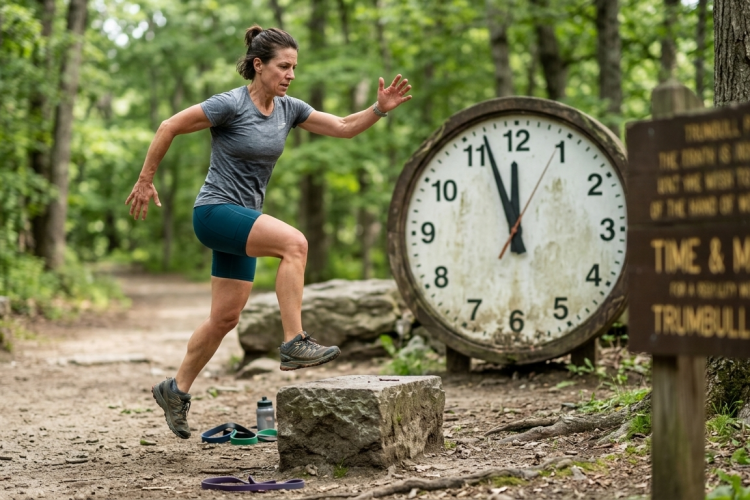
Most people feel it before they can name it. Somewhere in their early 40s, things start to shift. Recovery takes longer. The scale creeps up even though nothing changed. A flight of stairs that was effortless five years ago now leaves you slightly winded. You chalk it up to a bad week, a busy schedule, getting older. But here is what is actually happening inside your body — and why the decisions you make now matter more than you think.
The biological aging of muscle, bone, and cardiovascular function does not wait for retirement. It starts quietly in your late 30s and early 40s, accelerates through your 50s, and compounds dramatically after 60. By the time most people realize something is wrong, they have already lost significant ground. This post walks through what the science shows, decade by decade.
Your 40s: The Quiet Beginning
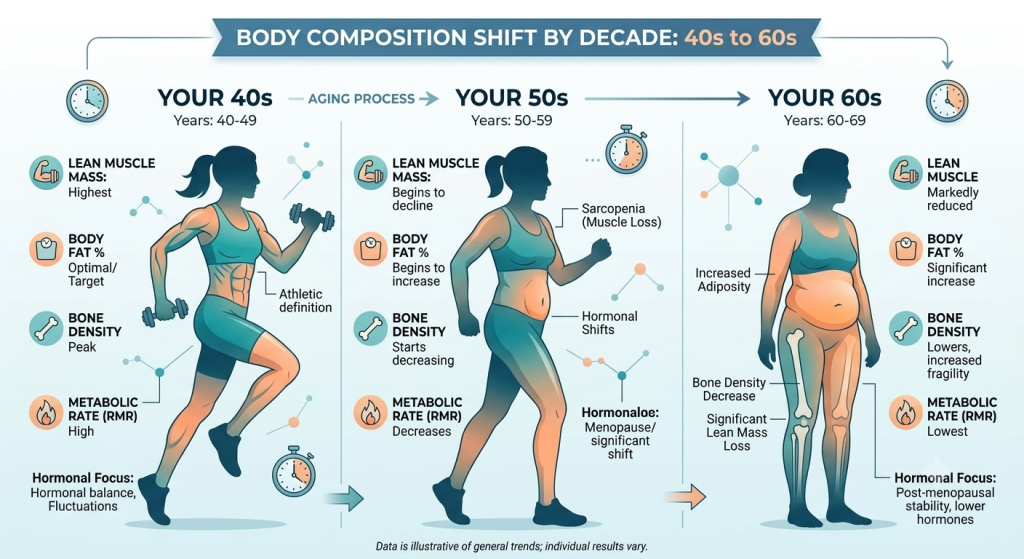
The changes in your 40s are real, but they are subtle enough to ignore — which is exactly the problem. Muscle mass begins declining at a rate of roughly 3 to 5 percent per decade, a process called sarcopenia. Bone density starts dropping at about half a percent to one percent per year. Testosterone and estrogen levels begin a slow but consistent descent. Your cardiovascular capacity, measured as VO2 max, declines at roughly one percent per year.
None of this feels catastrophic at 42 or 45. You can still do everything you did at 32. But the trajectory has been set. The body’s ability to build and retain muscle becomes measurably less efficient. Protein synthesis slows. Recovery from exercise takes longer. Body composition — the ratio of muscle to fat — begins quietly shifting even in people who have not changed their diet or activity level.
The critical point here is not to alarm you. It is to tell you that your 40s are actually the best decade to intervene. The losses are modest. Your body still responds extremely well to resistance training. The gap between where you are and where you want to be is still small. That changes quickly.
Your 50s: The Acceleration Begins
By the time you reach your 50s, several processes that were moving slowly in your 40s begin to accelerate simultaneously. Muscle loss increases to roughly 5 to 8 percent per decade — and the quality of remaining muscle fiber degrades as well, with fast-twitch fibers (responsible for power, balance, and reaction time) lost at a faster rate than slow-twitch fibers.
For women, menopause introduces a sharp additional hit to bone density. Estrogen plays a critical protective role in bone maintenance, and its decline in the early-to-mid 50s can accelerate bone loss to two to three percent per year during the transition years. Men are not exempt — testosterone continues declining and growth hormone drops significantly, reducing the body’s capacity to repair tissue and maintain lean mass.
VO2 max decline steepens to roughly 1 to 1.5 percent per year. What this means practically: activities that felt easy at 45 — carrying groceries up stairs, playing with children, hiking on uneven terrain — require noticeably more effort. Balance and coordination become subtly less reliable. The risk of a fall is not yet high, but the body is getting there.
Metabolic rate slows, partially due to muscle loss (muscle is metabolically active tissue) and partially due to hormonal changes. People who have maintained the same diet for decades often see weight gain in this decade without changing a single habit. This is not willpower failing — it is physiology changing.
Decade-by-Decade Decline: The Numbers
The table below summarizes the key physiological changes across each decade from your 40s to your 80s. Pay attention to how the numbers accelerate after 60.
Age | Muscle Mass Loss | Bone Density Loss | VO2 Max Decline | Key Hormone Change |
40s | ~3–5% per decade | ~0.5–1% per year begins | ~1% per year | Testosterone & estrogen start declining |
50s | ~5–8% per decade | Accelerates post-menopause (women) | ~1–1.5% per year | Growth hormone drops significantly |
60s | ~10–15% per decade | Fracture risk rises sharply | ~2% per year | Insulin resistance increases |
70s–80s | Up to 30–40% total loss from peak | Osteoporosis common; hip fracture risk major | Up to 50% lost from age 25 peak | Frailty, sarcopenia, cognitive decline risk |
Sources: American College of Sports Medicine (ACSM); National Strength and Conditioning Association (NSCA); research on sarcopenia and aging physiology.
Your 60s: The Compounding Effect
This is where the math gets serious. Losses that were occurring separately in your 40s and 50s now compound. Muscle mass decline reaches 10 to 15 percent per decade. Bone density losses create a meaningful fracture risk — a fall that would have been a bruise at 45 can become a broken hip at 65. VO2 max decline accelerates to roughly two percent per year.
Functionally, this decade is where many people notice they are no longer doing things they used to do without thinking. Getting up from the floor. Carrying heavy bags. Climbing stairs without holding the railing. Lifting objects overhead. These are not signs of laziness. They are signs of a body that has been losing capacity for 20 years without intervention.
Insulin sensitivity continues to decline, increasing the risk of type 2 diabetes. Chronic inflammation — a process researchers call inflammaging — becomes a significant background factor in joint pain, fatigue, and cognitive changes. The nervous system becomes less efficient at recruiting muscle fibers quickly, which directly affects balance and fall prevention.
The good news is that resistance training in your 60s has been shown in multiple studies to meaningfully reverse many of these trends. The ACSM’s position stand on exercise and aging makes clear that it is never too late to begin — and that strength training is the single most effective intervention for preserving functional independence. You can read more about our approach to training adults in their 60s and beyond on our
You can read more about our training approach for this population on our personal training services page, and see how we work with clients across Greenwich, Stamford, and Westport.
Your 70s and 80s: Why the Earlier Decades Determine This One
By the late 70s and into the 80s, the cumulative picture becomes stark. Research suggests that by age 80, the average person has lost 30 to 40 percent of the muscle mass they had at their peak in their mid-20s. VO2 max may be 50 percent below its youthful peak. Osteoporosis affects a significant portion of women and a growing number of men. Sarcopenia — clinically significant muscle loss — affects an estimated 10 to 40 percent of people over 70, depending on the diagnostic criteria used.
The consequences are not abstract. Hip fractures in adults over 75 carry a one-year mortality rate of approximately 20 to 30 percent. Loss of the ability to rise from a chair unassisted is one of the strongest predictors of hospitalization and loss of independence. The ability to carry one’s own groceries, climb stairs, or walk more than a block without stopping are not small things — they are the difference between living independently and not.
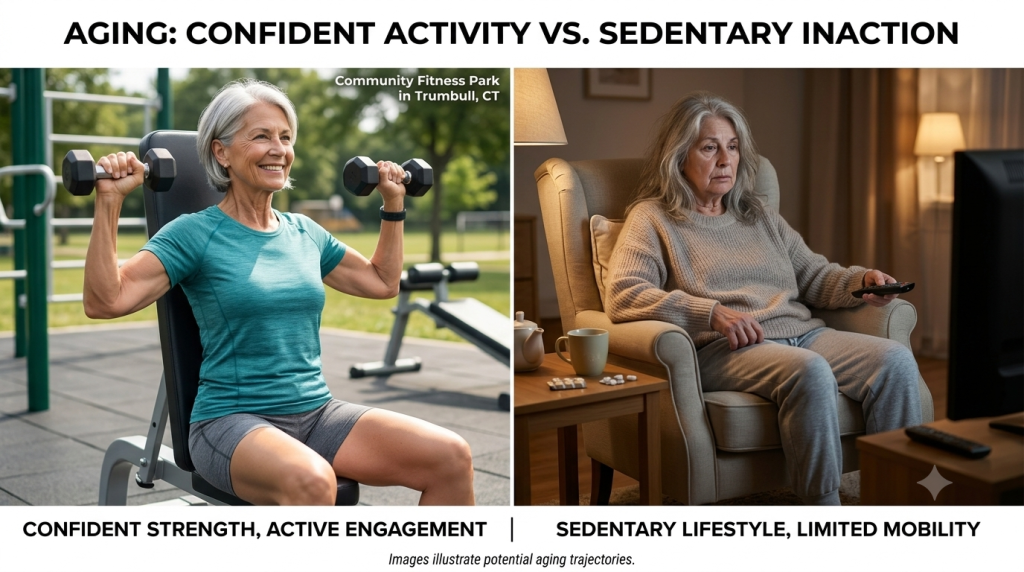
But here is what the research also shows: these outcomes are not inevitable. Adults who maintained regular resistance training and stayed physically active across their 50s and 60s arrive in their 70s and 80s with dramatically better muscle mass, bone density, and cardiovascular function than sedentary peers. The gap between an active 75-year-old and an inactive 75-year-old is often larger than the gap between an active 50-year-old and an active 75-year-old.
Where You Stand: Functional Risk by Decade
This table puts the numbers into practical terms — what the losses actually mean for everyday life.
Age | Approx. Muscle Mass Remaining | VO2 Max (% of Peak) | Functional Risk Level |
40 | ~97–100% | ~90–95% | Low |
50 | ~92–95% | ~80–85% | Low–Moderate |
60 | ~83–87% | ~65–72% | Moderate |
70 | ~72–78% | ~50–60% | Moderate–High |
80 | ~60–70% | ~40–50% | High |
Note: Values are population averages for sedentary to moderately active individuals. Trained adults show significantly better retention across all categories.
The Window Is Open — But It Does Not Stay Open Forever
The most important takeaway from the science is not that aging is inevitable and catastrophic. It is that the biological losses described above are dramatically modifiable through exercise — specifically through progressive resistance training. Study after study has shown that adults who begin a structured strength program in their 50s or 60s can recover years of lost muscle mass, improve bone density, restore cardiovascular function, and dramatically reduce fall risk.
What you cannot do is wait indefinitely. Each decade of inaction narrows the window and deepens the hole. The person who starts at 55 has a much easier road than the person who starts at 70 — not because 70 is too late, but because 20 more years of losses have accumulated.
If you are in Fairfield County and want to understand where you currently stand — and what a realistic, safe program looks like — contact us here. We work with adults at every stage of this journey, from the 45-year-old who wants to get ahead of the curve to the 72-year-old who is ready to start turning it around.
Carlos Perez, M.S. holds a Master’s degree in Exercise Science (Human Performance) from Southern Connecticut State University and is ACE certified as both an Orthopedic Exercise Specialist and Senior Fitness Specialist. He has provided private, in-home personal training to professionals in Greenwich, Stamford, Westport, and Darien since 2006, specializing in safe, efficient strength training for adults ages 45–70.