The Handshake Test: Why Grip Strength May Be the Most Important Number You're Not Tracking
For nearly 20 years I have trained adults in their own homes across Fairfield County, and there is one thing I check for, talk about, and quietly train in almost every client — often without them realizing it. It is not their squat, their heart rate, or the number on the scale. It is their grip. How firmly they can hold, carry, and hang on to something turns out to be one of the most revealing measures of how well they are aging — and one of the easiest to improve.
Most people never think about grip until they struggle with a jar lid or notice their tennis game slipping. But the research on grip strength is genuinely striking, and it points to something bigger than open jars. This post walks through what grip strength actually predicts, why it matters for everyday life and for the sports my clients love, and exactly what you can do about it — including a few simple tools you can keep at your desk or in your car.
What Grip Strength Actually Predicts
Here is the part that surprises people. Grip strength is not just a measure of how strong your hands are. It is one of the most reliable simple predictors of overall health and longevity that researchers have found.
Large studies have consistently shown that lower grip strength is associated with a higher risk of death from all causes. A meta-analysis pooling 40 studies found that each roughly 5 kg drop in grip strength was linked to a measurable increase in mortality risk. Another review combining data from around two million men and women concluded that muscular strength — with grip as the standard measure — is inversely associated with all-cause mortality, even after accounting for physical activity and cardiovascular fitness. In very old adults, those whose grip strength improved over time actually had lower mortality risk than those whose grip declined.
Why would a hand measurement predict so much? Because grip strength is a window into your whole body. It reflects total muscle mass, nervous system health, and how well you have maintained strength as you age. A strong grip generally means a body that has held on to muscle and function; a weak one is often the first visible sign that strength is slipping everywhere. It is not that squeezing harder makes you live longer — it is that grip is an honest mirror of the strength you have preserved throughout your body.
Note: Grip strength is a marker of overall strength and health, not a standalone treatment. The value is in what it reveals — and in the full-body strength training that improves it.
Grip and the Things That Keep You Independent
Beyond the longevity research, grip strength is tightly connected to the everyday abilities that determine whether someone stays independent. Carrying groceries in from the car. Lifting a suitcase into an overhead bin. Holding a railing firmly on the stairs. Picking up and carrying a grandchild. Opening a stuck door or a tight lid. Every one of these depends on the hands and forearms being able to generate and sustain force — and every one of them quietly gets harder when grip fades.
Grip strength is also linked to fall prevention and better outcomes after illness or hospitalization. When your hands can hold on with authority, you catch yourself on a railing instead of going down. This is exactly why I train it deliberately with my older clients — not as a party trick, but as a pillar of staying capable and safe.
Why Grip Matters: From Everyday Life to the Court
The table below shows how grip and forearm strength show up across the different parts of an active life.
Area of Life | How Grip Strength Shows Up |
Daily independence | Carrying groceries, lifting luggage, opening jars and doors, holding railings, gardening. |
Fall prevention | The ability to grab and hold a railing or surface firmly enough to catch yourself. |
Strength training | Grip is often the limiting factor — you can’t build the back, arms, or legs with weights you can’t hold. |
Tennis & racquet sports | Racket control, swing power, and endurance through a match; protection against wrist and elbow strain. |
Golf | Club control and consistent contact; stronger lead-side grip is associated with better performance. |
Health marker | A simple, reliable indicator of overall muscle strength, function, and longevity. |
Based on research on grip strength as a health biomarker and on forearm strength in racquet and club sports.
The Real Secret: Grip Is Built Into Good Strength Training
Here is what I tell every client who asks how to train their grip: you are already doing it, if you are training the right way. This is the part most people miss. You do not need a separate grip program bolted onto your week. The single best way to build grip strength is to hold and carry meaningful weight — which is exactly what proper strength training involves.
Loaded Carries — The Farmer's Walk
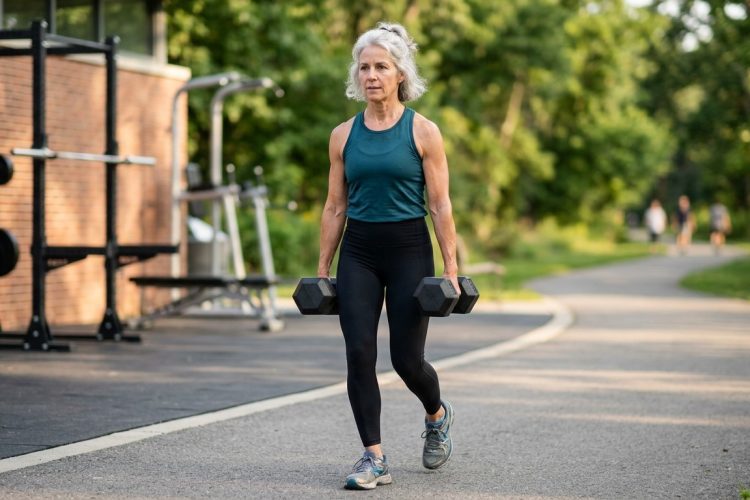
If I had to pick one exercise for grip, it would be the farmer’s carry — picking up a heavy weight in each hand and walking with it. I use loaded carries with nearly all of my clients, men and women alike, and for good reason. The farmer’s walk forces the hands, forearms, and fingers to hold a real load for time, while simultaneously loading the whole skeleton, challenging the core, and building the exact kind of functional strength that carrying groceries or luggage demands. It is grip training and full-body training in one honest movement — and it directly rehearses one of the most important real-world tasks there is: picking things up and carrying them.
Every Time You Hold a Weight, You're Training Grip
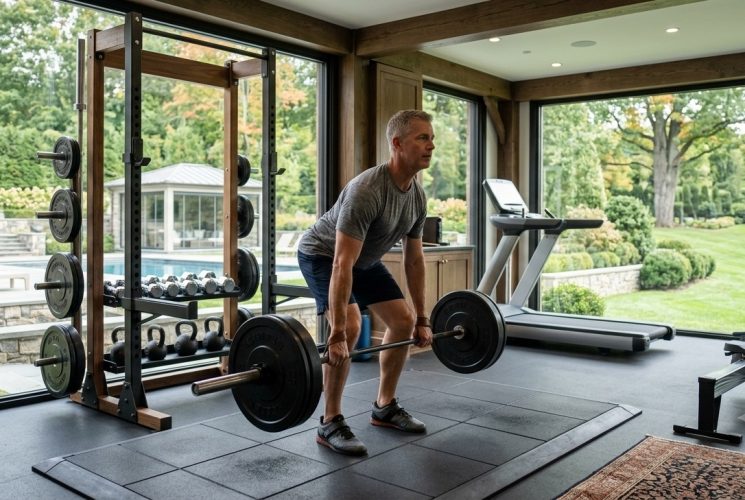
The same principle runs through all good resistance training. A dumbbell row, a deadlift, a suitcase carry, holding a kettlebell during a squat — in each case, if your hands cannot hold the weight, the set ends. That is why grip is so often the hidden limiting factor in strength training: people cannot build their back or legs with loads their hands cannot keep hold of. Train with real weight and strict form, and your grip strengthens right alongside everything else. This is one more reason I favor holding actual weights over machines that take the load out of your hands.
Grip, Forearms, and Keeping Your Wrists and Elbows Pain-Free
There is another side to this that matters enormously for my tennis and golf clients: strong, balanced forearms protect the wrists and elbows. Many of the nagging overuse problems in these sports — tennis elbow being the classic — come partly from weak or imbalanced forearm musculature being asked to do too much. When the muscles that move and stabilize the wrist and fingers are strong and conditioned, they share the load and shield the tendons and joints instead of leaving them exposed.
This is protection, not risk. The forearm has two main muscle groups — the flexors on the palm side and the extensors on the back — and a healthy hand needs both trained. Balanced strength through the forearm keeps the wrist and elbow resilient, reduces the risk of repetitive-strain problems, and keeps you swinging a racket or a club comfortably for years longer. For an active adult who wants to keep playing the sports they love, few things pay off like pain-free, well-conditioned forearms.
Simple Tools to Keep Handy — Desk, Car, and Everywhere Between
Loaded carries and strength training are the foundation. But one of the nice things about grip is that it responds well to small, frequent doses — which means you can supplement your training in the gaps of the day. A hand gripper or a squeeze ball in the car or on the desk gives you something useful to do at a red light, on a phone call, or between tasks. These are complements, not replacements for real training, but they are genuinely worth having within reach.
Here are the options I would point clients toward, from gentlest to most serious:
Tool | Best For | Why I Like It |
Soft squeeze ball or grip ring | Beginners, arthritis, gentle daily use | Low, forgiving resistance; easy to keep in a pocket, car, or desk drawer and squeeze anytime. A great starting point. |
Starter kit (e.g. FitBeast-style set) | Most people wanting variety | Usually includes a couple of adjustable grippers, a finger-extension band, a ring, and a ball — covers closing AND opening the hand, at low starting resistances. Best all-around value for the desk. |
Adjustable hand gripper | Progressing over time | One tool, multiple resistance levels, so you can add difficulty as you get stronger without buying more. Convenient and travel-friendly. |
Finger-extension band or ‘stretcher’ | Balancing the hand | Trains the muscles that OPEN the hand — the ones squeezing never works. Important for balance and for keeping the forearm healthy. |
Fixed metal gripper (e.g. Captains of Crush) | Serious, durable crush training | The gold standard for building real crushing strength — but fixed resistance means you buy by level. More than most of my clients need to start. |
Product categories synthesized from 2026 grip-strengthener reviews. Specific brands are examples, not endorsements. If you have arthritis, a hand or wrist injury, or are recovering from surgery, start gentle and check with your clinician first.
My honest advice: most people are best served by a low-cost starter kit kept somewhere visible — the desk or the car console — plus the finger-extension band so you are training the hand to open as well as close. Then let your actual strength training, and especially your loaded carries, do the heavy lifting. A few squeezes a day at a stoplight will not replace a farmer’s walk, but they keep the hands engaged and add up over time.
If you want to see how we build safe, progressive strength work — loaded carries included — for adults over 50, you can read more on our personal training services page, and how we work with clients across Greenwich, Stamford, and Westport.
The Bottom Line
Grip strength is a small measurement that tells a big story. It predicts longevity, it determines whether you can carry your own life around independently, and it quietly powers your tennis and golf for years longer than they would otherwise last. The best part is that you do not need anything exotic to build it. Hold real weight with good form, do your loaded carries, train your forearms in both directions, and keep a gripper or squeeze ball within arm’s reach for the odd moment. Do that, and you are strengthening far more than your hands.
If you are in Fairfield County and want a strength program built around where you actually stand — one that keeps you carrying, playing, and living independently for the long haul — contact us here. We work with active adults at every stage, from those getting ahead of the curve in their 40s to those turning things around in their 70s and beyond.
Carlos Perez, M.S. holds a Master’s degree in Exercise Science (Human Performance) from Southern Connecticut State University and is ACE certified as both an Orthopedic Exercise Specialist and Senior Fitness Specialist. He has provided private, in-home personal training to professionals in Greenwich, Stamford, Westport, and Darien since 2006, specializing in safe, efficient strength training for adults ages 45–70.