Get Your Body Ready for Golf Season — A Smart 8-Week Approach
Golf season in Connecticut is about 8 weeks away. That’s enough time to make a real difference in how you feel on the course — and how you play.
If you’ve spent the winter months less active than usual, your body will let you know the first few rounds. Soreness, stiffness, maybe that familiar twinge in your back or shoulder. It doesn’t have to be that way.
The Self-Assessment
Ask yourself:
- Do I usually start the season sore after the first few rounds?
- Do I deal with back, hip, shoulder, or knee discomfort during or after playing?
- Have I had golfer’s elbow, rotator cuff issues, or wrist problems?
- Do I take ibuprofen just to play comfortably?
- Does my swing feel inconsistent or off-balance?
- Have I cut back on how often I play because of pain or fatigue?
If any of that sounds familiar, now is the time to do something about it — not after you’ve already aggravated something in April.
Why Golf Is Harder on Your Body Than You Think
Golf doesn’t look like a demanding sport. There’s no running, no contact, no visible exertion. But that’s deceptive.
A golf swing requires explosive rotation through your torso, complex and precisely timed hip and shoulder movement, and what exercise scientists call “sequential neuro-conditioning” — your brain coordinating multiple muscle groups firing in a specific order, at high speed, repeatedly.
Most recreational golfers don’t have the mobility, stability, or strength to do this safely round after round — especially after a sedentary winter. The result? Your body compensates. You rotate through your lower back instead of your thoracic spine. Your shoulders do the work your hips should be doing. And over time, those compensations become pain, limitation, and inconsistency in your swing.
This is why so many golfers deal with the same nagging issues year after year: low back pain, hip tightness, shoulder impingement, elbow tendinitis. It’s not bad luck. It’s a body that hasn’t been prepared for what golf actually demands.
What 8 Weeks of Targeted Training Can Do
A focused pre-season program addresses the specific demands of golf before you ask your body to perform them under pressure. Here’s what that training targets:
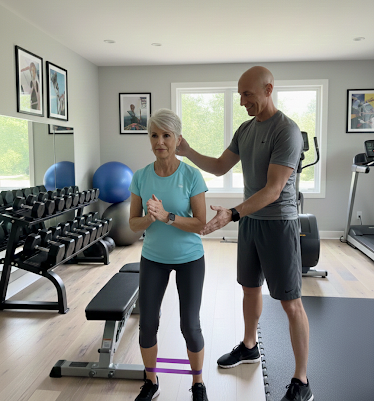
Dynamic Flexibility This isn’t static stretching. Dynamic flexibility uses controlled, functional movements to take your joints through their full range of motion — especially in your hips, thoracic spine, and shoulders. These are the same movements you can use as a pre-round warm-up once the season starts.
Core and Rotational Strength Your core is the engine of your swing. But “core” doesn’t mean crunches — it means training your torso to generate and transfer rotational power while keeping your lower back protected. This is where a lot of golfers lose both power and safety.
Balance and Stability A consistent, controlled swing requires stability from the ground up. If you’re shifting, swaying, or losing your base, your swing will never be repeatable. Balance work is often overlooked but makes a noticeable difference in swing consistency.
Conditioning If you’re gassed on the back nine, your form breaks down, your focus fades, and your scores suffer. You don’t need to run marathons, but you do need enough cardiovascular fitness to stay sharp for 18 holes — especially if you’re walking the course.
My Approach: How the Training Works
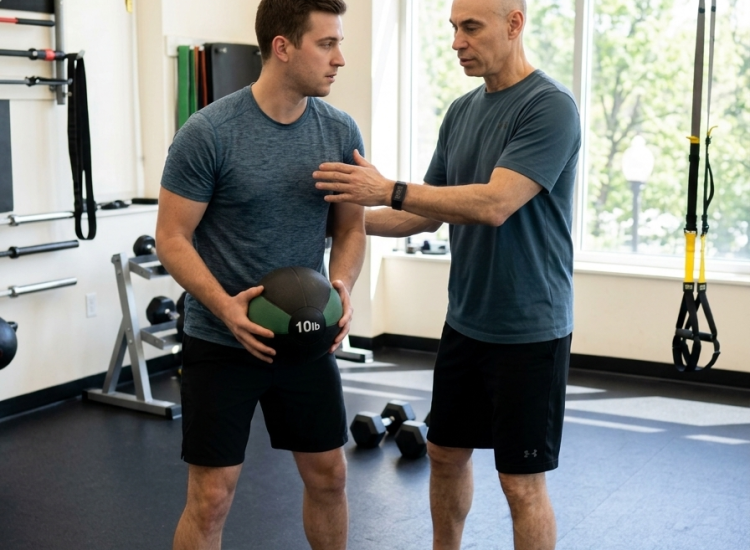
There are many ways to approach golf fitness, but trying to analyze and correct every flaw in your swing can be time-consuming, mentally exhausting, and frustrating. My approach is simpler: strengthen and condition your body to perform a high-level golf swing without injury.
I do this through a combination of Dynamic Flexibility and Tabata-style interval training (a form of High-Intensity Interval Training, or HIIT).
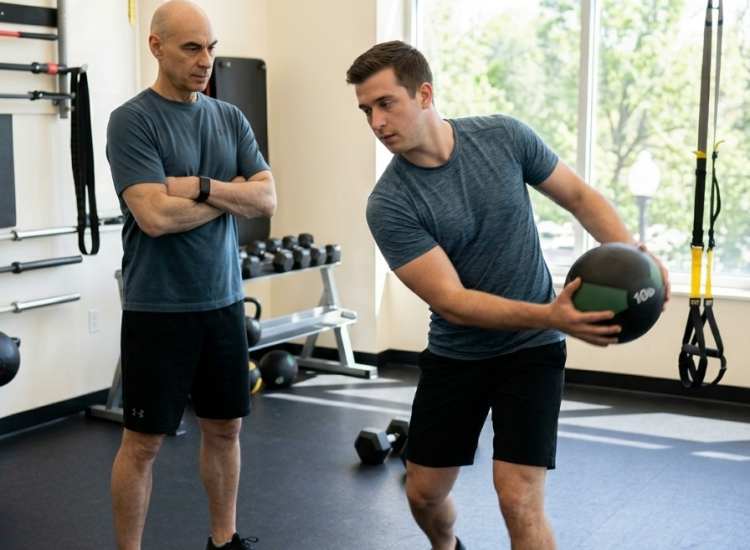
Dynamic flexibility prepares your body to move well. Tabata-style training — short bursts of intense, golf-specific movement alternated with brief recovery — builds the power, coordination, and endurance you need on the course.
What a Typical Session Looks Like
Here’s the structure of a golf-focused training session:
Warm-Up and Dynamic Flexibility (15-20 minutes) Functional movements designed to optimize range of motion in your hips, thoracic spine, and shoulders. This is also the routine you’ll use before tee time once the season starts — so you’re building a habit that pays off all year.
Interval Training with Golf-Specific Movements (20 minutes) Tabata-style rounds that include rotational power exercises, hip hinge movements, and core stability work — all at intensities that challenge your cardiovascular system while reinforcing movement patterns you’ll use in your swing.
Targeted Resistance Training (15-20 minutes) Strength exercises for the legs, hips, core, back, and arms — the muscle groups that drive and stabilize your swing. This isn’t bodybuilding. It’s training your body to be stronger in the positions and movements golf demands.
The Bottom Line
You’ve got 8 weeks. That’s 2-3 sessions per week, 16-24 total workouts. Enough time to show up to your first round feeling strong, loose, and ready — instead of spending the first month of the season working through rust and soreness.
This isn’t about becoming a tour pro. It’s about playing pain-free, playing more often, and maybe shaving a few strokes because your body is actually cooperating with what you’re asking it to do.

Ready to Start?
If you want help putting together a plan tailored to your body and your game, let’s talk about what that might look like.
Carlos Perez | Optimal Personal Training (203) 520-9886
Carlos Perez is a certified personal trainer specializing in adults aged 45-70. With a Master’s degree in Exercise Science and certifications in orthopedic exercise and senior fitness, he has helped clients throughout Fairfield County build sustainable fitness routines since 2006.